
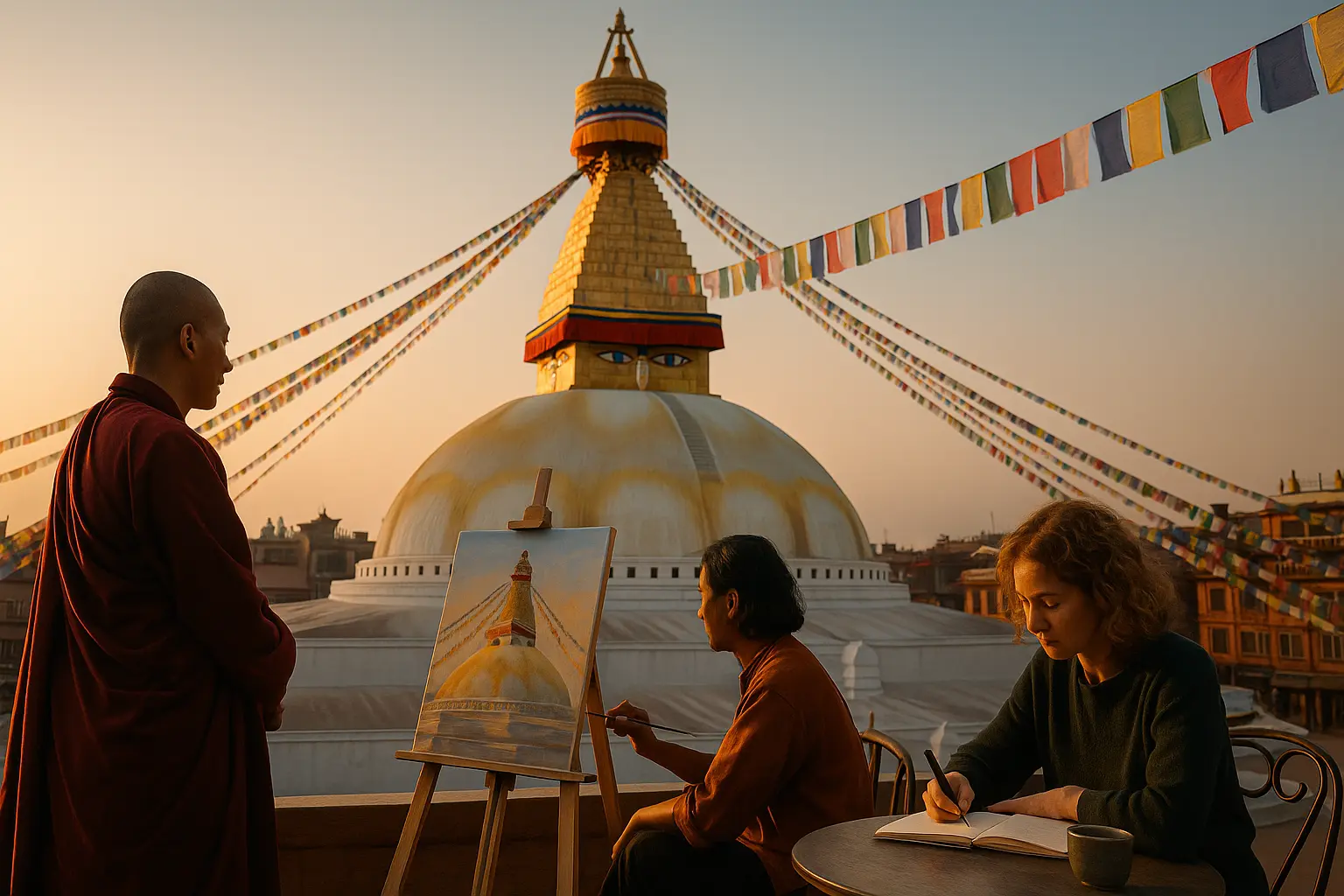
Where Silence Sparks Creation
There are places that sing to the soul, and then there are places that hum. Boudhanath is the latter.
If you’ve ever stood quietly before the stupa as the sun rises, you’ve felt it, that gentle vibration that settles the mind and stirs something deeper. The scent of juniper, the soft murmur of chants, the slow turning of prayer wheels, it’s not noise, it’s rhythm. And in that rhythm, many have found their voice.
Over the years, Boudha has become more than a pilgrimage site. It’s a quiet refuge for creators, a sanctuary where inspiration arrives not through intensity, but through presence.
The Spiritual Atmosphere of Boudhanath
Boudhanath Stupa isn’t just a monument. It’s a living, breathing mandala. Every day from before sunrise, monks, nuns, elders, and pilgrims begin their kora, walking clockwise around the stupa with prayer beads in hand.
There is a field of stillness here that seems to expand the moment you arrive. You slow down, not because you’re told to, but because the energy invites you to.
The chants from nearby monasteries create a low, continuous current in the air. Prayer flags snap gently in the wind. Pigeons take flight and land without panic. Even the light here feels like it filters down through layers of prayer.
It’s no wonder artists find themselves reaching for their sketchbooks, poets for their notebooks, and monks for their bells.
Why Artists Come to Boudha
Walk around the stupa mid-morning and you’ll see it: someone sitting cross-legged near Tamang Gompa sketching the dome, a painter under a rooftop umbrella blending oils into a golden sky, a photographer waiting quietly for the perfect light on a butter lamp altar.
It’s not just the visual beauty. It’s the way Boudha makes space for contemplation. The textures of carved wood, the movement of robes, the interplay of shadow and incense, these things speak in a language artists understand.
One of the best places to explore this artistic spirit is the Himalayan Art Council. Here, traditional thangka painting, paubha scrolls, and contemporary Himalayan art come together. It’s a platform that honors artist creativity as a living tradition, not a relic of the past.
Explore the Himalayan Art Council
Whether you’re an artist looking to study form or a traveler simply seeking soulful visual beauty, this platform opens a rare doorway into both ancient craftsmanship and modern expression.
A Home for Poets and Writers
The rhythm of Boudha is perfect for writing. The turning of wheels, the chanting, the soft footsteps, it all becomes a kind of metronome for thought.
Many writers come here to finish manuscripts, begin memoirs, or simply keep a quiet journal of their inner journey. There’s no pressure to produce, just a subtle invitation to pay attention. That’s where poetry begins.
Rooftop cafés like Garden Kitchen or Boudha Café de Mandala (the in-house café at Boudha Mandala Hotel) are favorite spots for early-morning writing. With a pot of Tibetan tea and the stupa glowing in front of you, words tend to arrive without being forced.
Some say Boudha gives language back its silence. The kind of silence where meaning grows.
Monks and the Art of Mindful Living
Creativity doesn’t always take the form of a brush or pen. In Boudha, some of the most profound artists are the monks.
Watch a monk arrange butter lamps, each flame lit with care. Or a nun sweeping the courtyard, her movement steady and unrushed. Or the precise symmetry of a thangka painter dipping a brush into pigment ground from stone.
In these acts, there is rhythm. There is precision. There is presence. And that is the essence of art.
The architecture itself is a canvas: vivid murals, carved dragons above doorways, multicolored banners dancing in the wind. Everywhere you look, you see the imprint of spiritual creativity.
Staying in Boudha as a Creative
To truly enter the flow of this place, you need to stay nearby. When you can walk out of your room and be at the stupa in ten seconds, you stop chasing moments,you live inside them.
Boudha Mandala Hotel offers just that. Stupa-view balconies, a calm rooftop for morning writing, and a peaceful café below where monks and travelers alike gather. For long-stay artists or digital nomads working on slow creative projects, the hotel feels like a retreat center without the formality.
The staff understands pilgrimage. They understand silence. And they’ll help you find incense, art supplies, or even the nearest monastery workshop, without hesitation.
Final Reflection
You won’t find fast Wi-Fi on every rooftop here, and that’s the point. Boudha doesn’t invite distraction. It invites you to notice.
The way a monk walks. The flutter of a robe. The color of dusk. The echo of a bell long after it’s been rung.
This is where creation begins, not from pressure, but from quiet.
So if you’re a poet in search of stillness, a painter waiting for color to return, or simply someone who’s forgotten how to listen to silence, come to Boudha.
Walk slowly. Look closely. The inspiration is already here.
If you’re seeking a peaceful stay just steps from the stupa, Boudha Mandala Hotel offers long-stay options, a rooftop café, and a warm welcome rooted in the spirit of presence.