
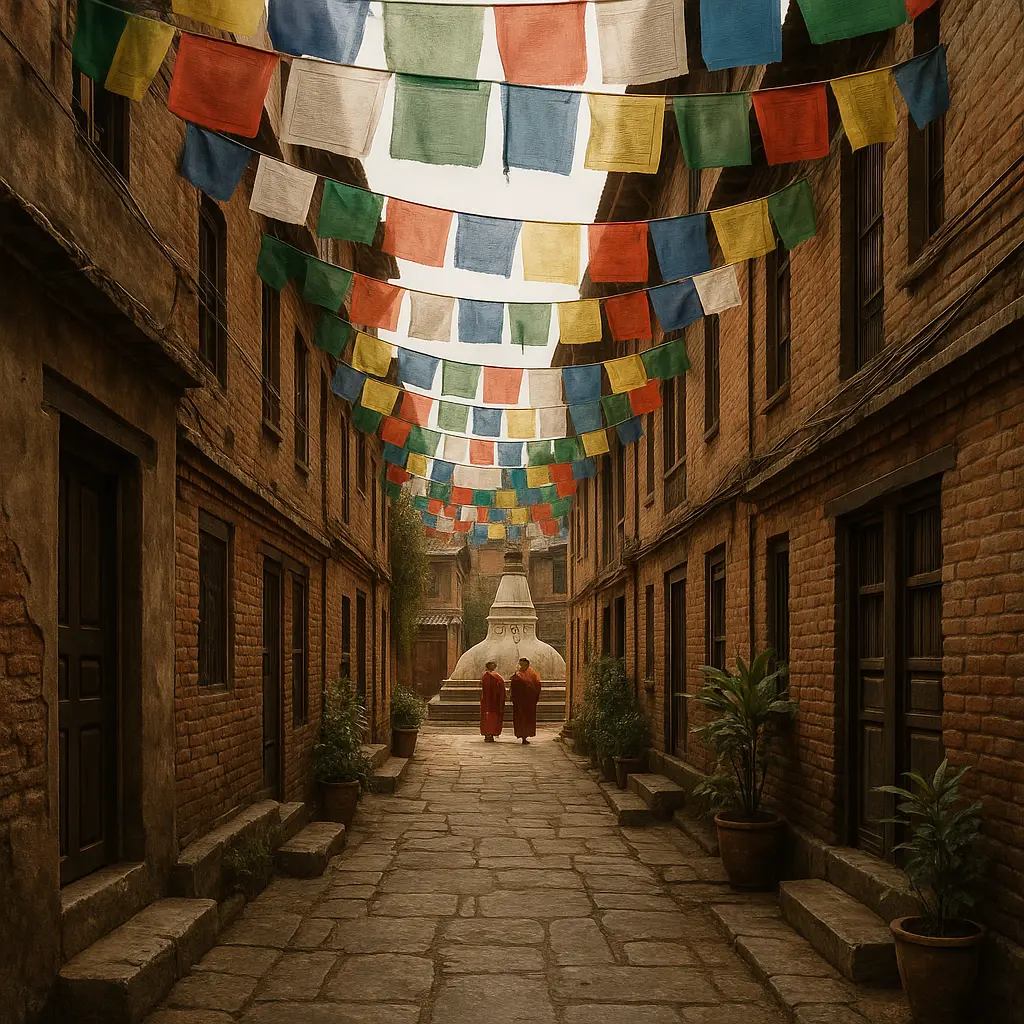
There’s a stillness in Boudha that draws you in. But it doesn’t end at the circle of the great stupa. If you follow the soft rustle of prayer flags, the scent of incense drifting from open windows, and the occasional sound of a conch shell calling monks to prayer, you’ll begin to see another Boudha. One that lives quietly, humbly, just beyond the main kora path.
This isn’t a place of signs and schedules. It’s a place of wandering. The alleys of Boudha don’t shout. They whisper. And if you listen closely, they’ll show you something unforgettable.
Why the Side Alleys Matter
While most visitors stay near the main stupa path, locals know where the soul of Boudha truly breathes. It’s in the narrow lanes behind monasteries. In the flicker of a butter lamp seen through a half-open door.
In the quiet rhythm of a nun sweeping her courtyard at dawn.
These side paths are not hidden to those who walk slowly. They reveal themselves with time, with trust, and with presence. This is where devotion lives — not performed, but practiced.
The Prayer-Flag Alley Behind Tamang Gompa
One morning, I followed a monk holding a small bundle of butter lamps into a quiet alley behind Tamang Gompa. What opened before me was a corridor of prayer flags, stretching overhead from rooftop to rooftop, casting colorful shadows on the brick path below.
At the end, I found a tiny courtyard with a stone stupa no taller than my waist. Two nuns were offering incense. One smiled. No words were needed. That moment stayed with me longer than any panoramic photo ever could.
The Left Turn at Lotus Bakery
Everyone knows Lotus Bakery. But few take the left turn just before its entrance.
If you do, you’ll find yourself walking toward a monastery courtyard where birds sing louder than any traffic horn, and the air smells like old wood and saffron robes. On my second visit, I sat there for nearly an hour, not planning to. I had brought a journal, but I didn’t write. I just sat, as bells rang from a nearby puja and a child offered a marigold to a statue.
Sometimes the quietest places say the most.
The Teahouse With No Name
One evening, after a soft rain had washed the dust from the bricks, I wandered into an alley in the northeast corner of the Boudha circle. I was cold, slightly lost, and looking for nothing in particular. That’s when I saw three monks sipping tea inside a small shop with no sign.
The smell of salty butter tea pulled me in. They welcomed me without words, only a nod. The tea was hot, the air was still, and for a moment I forgot I was a traveler. I was just there, present, sipping from a heavy glass mug, sharing space with devotion.
A Secret Rooftop With a Clear View
Not all rooftops in Boudha are listed on TripAdvisor.
One family-run lodge, tucked behind a gift shop near the west side of the stupa, opens its roof only if you ask kindly. I climbed three narrow flights of stairs and emerged onto a small terrace strung with fresh prayer flags. No music, no menu, no crowd.
Just a full, unbroken view of the stupa glowing in the setting sun. Below, the prayer wheels turned with the rhythm of old hands. Beside me, a cat curled up beside a butter lamp. I didn’t take many photos. I didn’t need to.
Wandering as a Spiritual Practice
Boudha is a mandala, not a museum. And just like a mandala, its gifts are found when you let go of structure.
The alleys here don’t follow a plan. Some turn sharply. Some end abruptly. Some open to light, others into shadow. But every corner invites you into deeper presence. To walk with no agenda. To observe without labeling. To feel instead of chase.
It’s a reminder that wandering isn’t the opposite of purpose. Sometimes, it is the purpose.
Why Staying Nearby Changes Everything
To truly uncover the hidden gems of Boudha, you need to stay close. When you stay at a place like Boudha Mandala Hotel, just 10 seconds from the stupa, the entire neighborhood becomes your backyard. You wake with the monastery bells. You wander out barefoot for morning kora. You meet shopkeepers who start to recognize you not as a guest, but as a neighbor.
It’s this sense of belonging that makes the alleys open up. The slower you go, the more they reveal.
Conclusion
Not every traveler will find these side alleys. Not because they’re hard to reach, but because they ask you to slow down, to notice, to be still enough to see.
So take the unknown turn. Linger a little longer by a closed temple gate. Smile at the stranger sweeping the doorway. And walk as if every step might lead to a hidden shrine.
Because in Boudha, it just might.
If you’re looking for a peaceful, soulful stay while exploring the secret side of Boudha, Boudha Mandala Hotel offers stupa-view rooms, long-stay options, and a calm, retreat-like atmosphere just steps from the circle.