
Key Takeaways
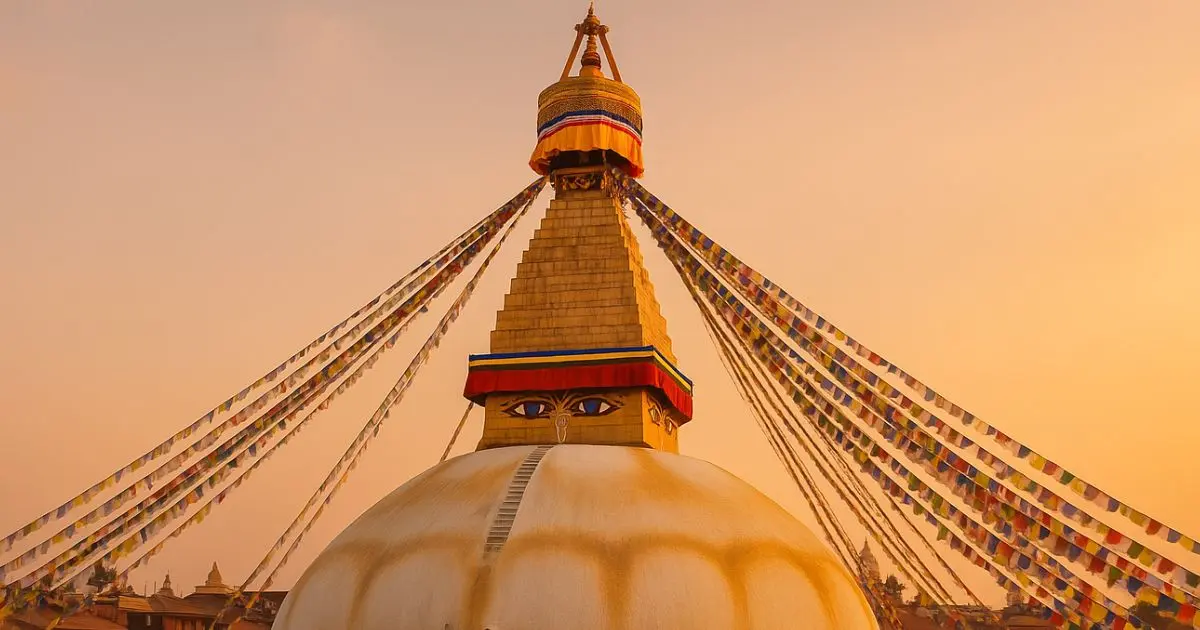
Boudhanath Stupa in Kathmandu is one of the holiest Buddhist sites in the world and the heart of Tibetan Buddhism in Nepal. Rooted in ancient legends and built during the Licchavi period, it has grown from a simple act of devotion to a sacred monument that holds relics, prayers, and generations of seekers.
After the 1959 Tibetan diaspora, Boudha became a refuge and spiritual center, now surrounded by dozens of monasteries. More than history, Boudha is a living shrine of resilience, faith, and inner peace.
Introduction
When you walk through the narrow lanes of Boudha and suddenly emerge into the vast circle of sky and stupa, something shifts. The pace of life slows. The air smells like juniper and melted butter. Prayer wheels spin in sync with ancient mantras. And at the center, like a spiritual compass, stands the towering white dome of Boudhanath Stupa.
This isn’t just a monument. It’s a witness to centuries. A sacred pulse in the middle of Kathmandu. Its story is woven with myth, migration, ritual, and quiet resilience. To know Boudha is to understand why the spiritual heartbeat of Tibetan Buddhism continues to echo from this place.
The Legend of a Poultry Keeper: The Mythical Origin
According to Buddhist legend, Boudhanath was built by a humble poultry-keeping woman and her four sons. Moved by faith, she petitioned the king for a small piece of land to build a shrine for the relics of Kassapa Buddha. The king granted her wish, and with love, devotion, and the help of her sons, she constructed what became one of the greatest stupas of the Buddhist world.
This legend continues to live in the local consciousness, a reminder that deep faith, even from someone seen as ordinary, can create something timeless and holy. The stupa is more than a structure; it’s a monument to the power of intention.
Historical Foundations: Licchavi Period and Early Buddhism
Beyond the myth, historical evidence places the construction of Boudhanath during the Licchavi era, around the 5th to 6th century CE. In ancient texts, the stupa was known as Khasti Chaitya , with “Khasti” meaning “dew.” During a long drought, locals are said to have cultivated the land with collected dew to support the construction.
This was a time when Nepal was a vital center of Buddhist learning and trade between India and Tibet. Boudhanath became a sacred stop on early pilgrimage routes. It was, and remains, a powerful representation of the dharma in stone.
A New Chapter: The Tibetan Refugee Era Post-1959
The year 1959 marked a profound transformation for Boudha. After the Chinese invasion of Tibet, thousands of Tibetan refugees crossed the Himalayas and settled in the Boudha area. The stupa, already sacred, became a new spiritual home for a displaced people.
Dozens of Tibetan Buddhist monasteries, including Shechen Monastery, Ka-Nying Shedrub Ling, and Thrangu Tashi Yangtse, were built around the stupa. Each lineage, from Nyingma to Gelug, found space here. The stupa became more than a historical site. It became a living monastery, a center for ritual, community, and the continuation of a threatened tradition.
Even today, Boudha is one of the only places outside Tibet where Tibetan Buddhism thrives so openly and fully.
Boudhanath as a UNESCO World Heritage Site
In 1979, UNESCO declared Boudhanath a World Heritage Site, not just for its architecture, but for its cultural and spiritual value. The stupa is one of the largest spherical stupas in the world. Its design follows a mandala pattern, representing the universe, with the dome symbolizing emptiness, and the 13 spires representing stages toward enlightenment.
After the 2015 earthquake, the stupa suffered significant damage. But the restoration that followed, funded by local monasteries and global Buddhist communities, became a symbol of collective healing and resilience.
Spiritual Importance in Tibetan Vajrayana Practice
Boudhanath isn’t just sacred because of history , it is sacred because of what happens there every single day.
– Circumambulation (kora): Devotees walk clockwise around the stupa while reciting mantras.
– Butter lamp offerings: Symbolic acts of light and wisdom
– Prayer flags: Sending compassion to all directions
– Prostrations: Practiced with full-body devotion, especially during dawn and dusk
It’s believed that walking the kora mindfully purifies lifetimes of karma. For Vajrayana practitioners, Boudha is a place where the veil between seen and unseen feels especially thin.
Festivals and Ritual Rhythms at the Stupa
Some of the most powerful experiences at Boudha come during major Tibetan and Buddhist festivals:
– Losar: Tibetan New Year marked with music, prayer, and color
– Buddha Jayanti: Celebrating the Buddha’s birth, enlightenment, and passing
– Lhabab Duchen: Honoring the Buddha’s return from heavenly realms
These aren’t tourist events. They are living rituals, participated in by monks, nuns, and families. Butter lamps line the base of the stupa. Chanting fills the air. It is devotion in motion.
A Living Pilgrimage Site: Why Boudha Still Matters
In a fast-moving world, Boudhanath remains a place where the sacred slows you down. For many Tibetans and Himalayan Buddhists, visiting Boudha at least once is a lifetime goal. For others, it becomes a daily rhythm , a morning kora, an evening lamp. The stupa radiates peace not only because of its design, but because of the countless acts of devotion offered here for over 1500 years. It is a center of collective consciousness, a space for refuge, remembrance, and recommitment to the path.
Reflection: The Wisdom Hidden in the Stones
I remember sitting on a rooftop café one dusky evening, sipping salt-butter tea while watching hundreds of butter lamps flicker around the stupa. An old monk passed by below, spinning a prayer wheel slowly. Children chased pigeons. Somewhere, a bell rang.
In that moment, I felt what many before me have felt: Boudha is not just a place you visit. It is a place that visits something inside you.
Conclusion
The history of Boudha is not written in dry records; it is carried in footsteps, lit in butter lamps, and whispered through mantras. From the humble prayer of a poultry keeper to the resilience of an exiled community, Boudha teaches us that the sacred is not fixed in stone, but renewed with every offering.
To walk around Boudhanath is to walk with history, with spirit, and with generations of hope.
If you wish to stay immersed in the peaceful rhythm of this sacred place, Boudha Mandala Hotel offers spiritually aligned rooms just 10 seconds from the stupa, a perfect base for slow travel, retreat, and reflection.