How to Get from Tribhuvan Airport to Boudha

Key Takeaways
Boudhanath is just 4–5 kilometers from Kathmandu’s Tribhuvan International Airport, making it a perfect first destination. Travelers can choose from prepaid taxis (NPR 800–1200), ride apps like Pathao or InDrive (NPR 350–500), budget microbuses (NPR 20–30), or a pre-arranged hotel pickup. This guide explains all options clearly, with up-to-date fares, safety advice, and helpful cultural tips.

Introduction
The moment you step out of Tribhuvan International Airport, you’re hit by a mix of warm air, honking traffic, and the unfamiliar rhythm of Kathmandu. For many travelers, especially those coming for retreat, pilgrimage, or mindful exploration, Boudha is the perfect place to begin.
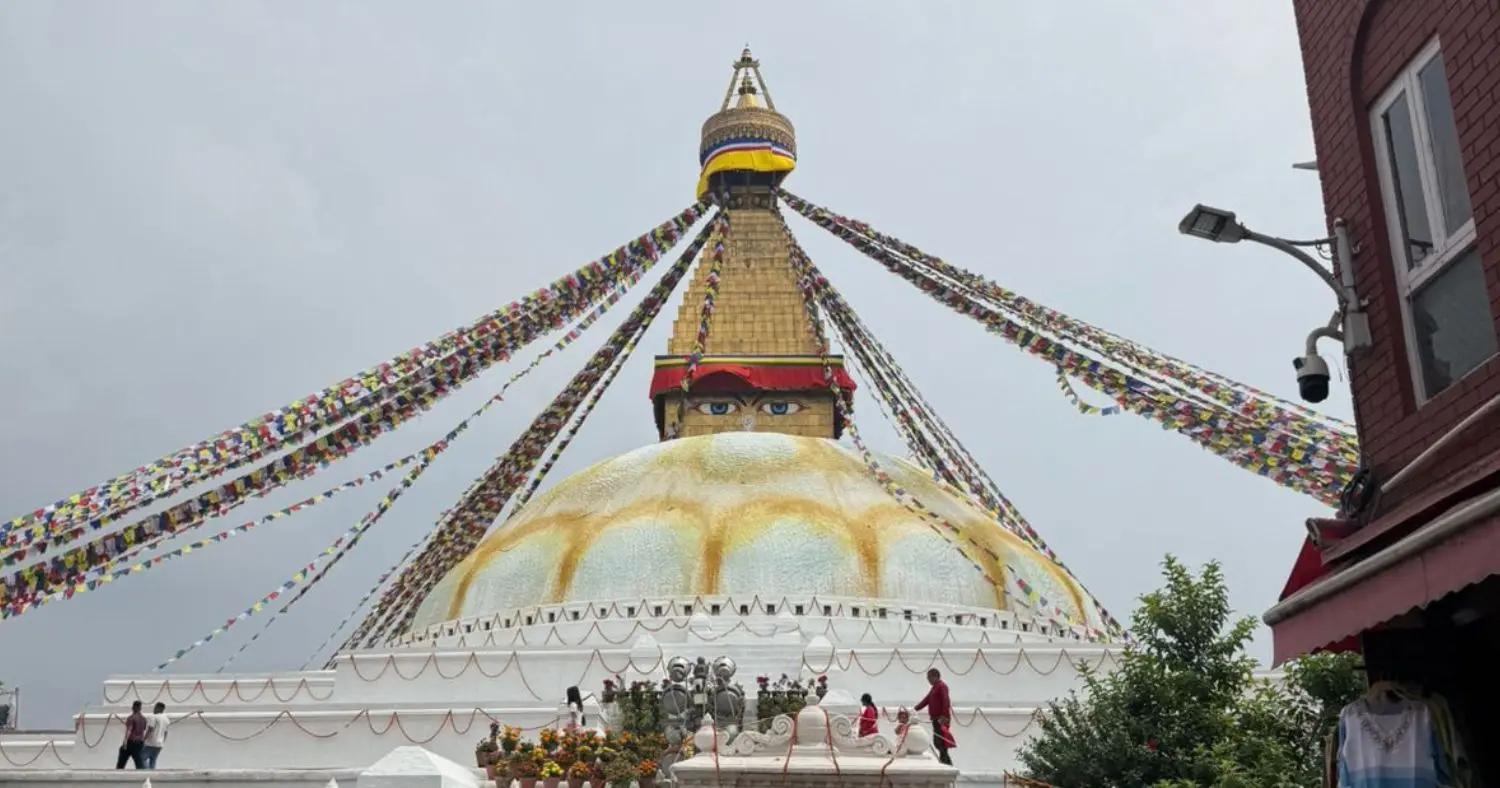
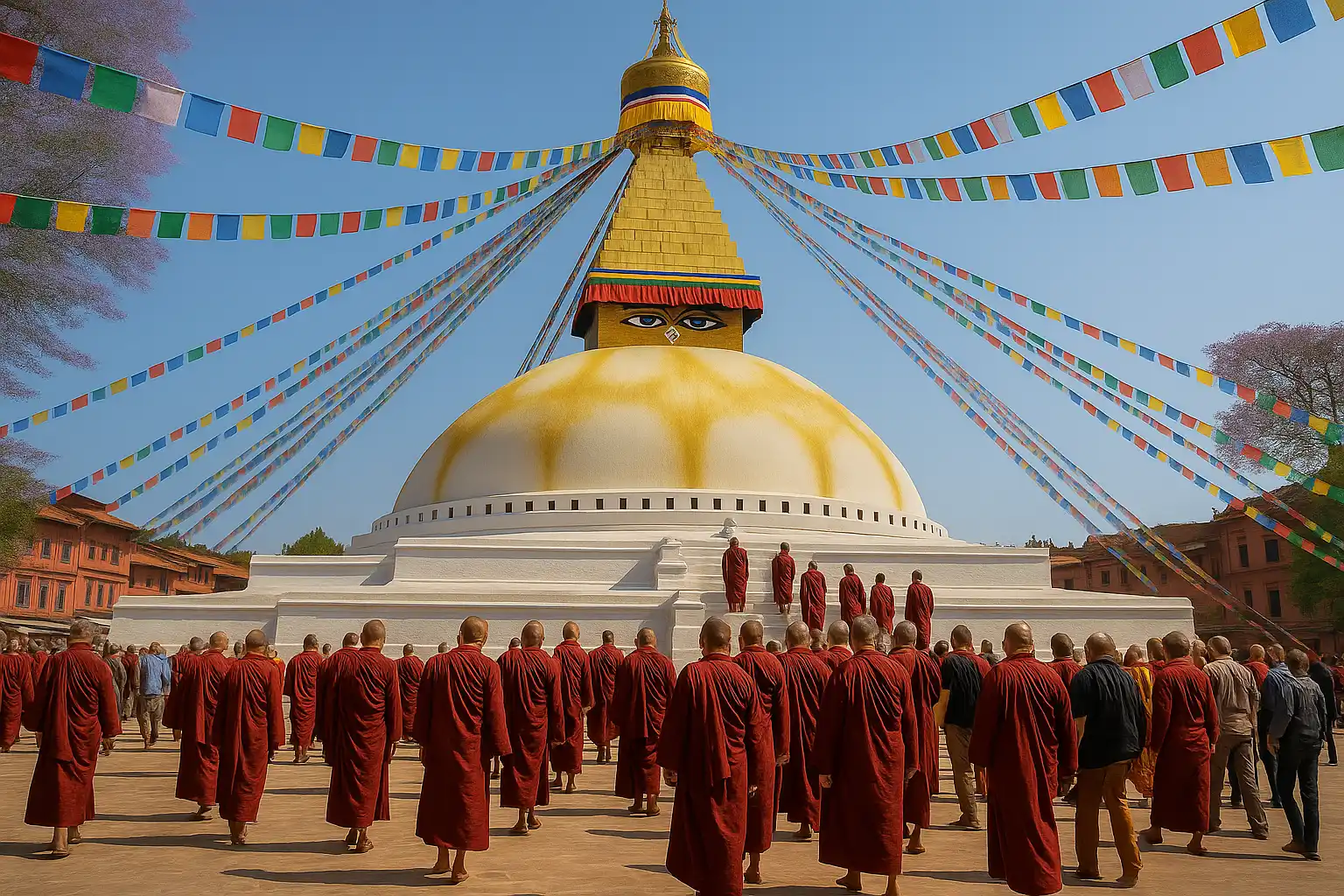
Unlike Thamel’s backpacker chaos, Boudha greets you with prayer wheels, monks in maroon robes, and the gentle presence of the great stupa, and it’s only about 20 minutes away from the airport.

But how do you get there easily, safely, and without overpaying? Let’s break down your options.

How Far Is Boudhanath Stupa from Tribhuvan Airport?

Boudhanath is just 4 to 5 kilometers northeast of Tribhuvan International Airport (TIA). In smooth traffic, it takes about 15–20 minutes by vehicle. During peak hours, like late afternoon or festivals, it may take up to 30 minutes.

The drive follows the Ring Road and turns off near Gaushala, leading into the peaceful Boudha neighborhood.

Option 1: Taking a Prepaid Taxi from the Airport
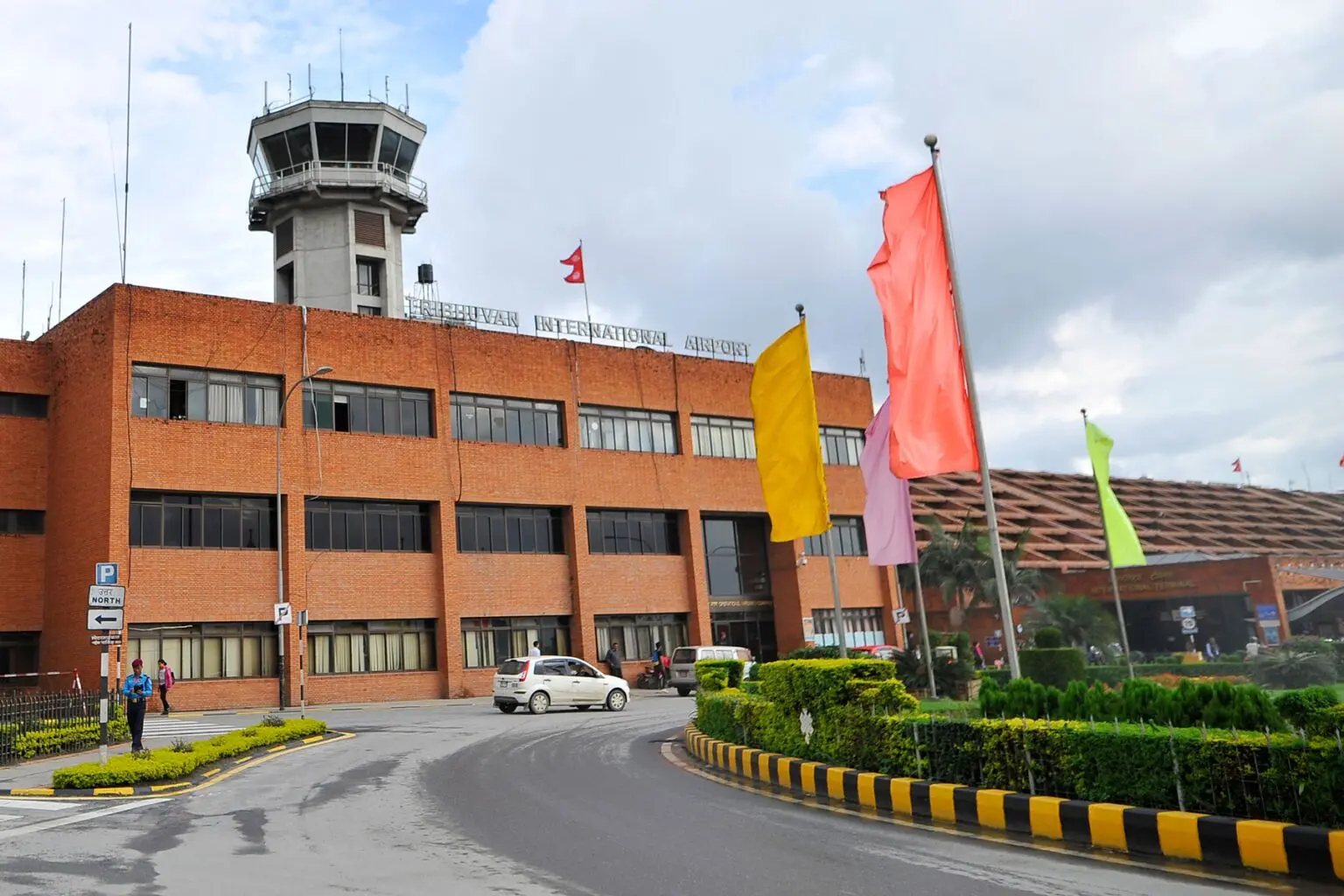
For many first-time travelers, the prepaid taxi counter inside the airport terminal is the most straightforward choice.
• Where to find it: Inside the arrivals area, just past customs
• Cost: NPR 800–1200 to Boudha, depending on your arrival time

Tips:
• Always confirm the destination and fare
• Carry small change if possible
• Don’t feel pressured by unofficial taxi drivers

Prepaid taxis are safe and official, and drivers generally know where Boudha is.

Option 2: Using Ride-Hailing Apps like Pathao or InDrive

If you have a Nepali SIM or access to Wi-Fi/data, ride apps are cheaper and increasingly reliable.

• Apps to use: Pathao (Nepali Uber alternative), InDrive (you bid your price)
• Estimated fare: NPR 350–400 to Boudha
• Wi-Fi: Tribhuvan Airport has limited free Wi-Fi, but local SIMs are cheap
• Tip: You may need to walk a few steps outside the airport gate to meet your driver

Digital nomads and younger travelers often prefer this method.

Option 3: Public Bus or Microbus (Budget Option)

For the adventurous or ultra-budget traveler, you can take a microbus or public Sajha Yatayat bus from the main road outside the airport gate.

• Cost: NPR 20–30
• Route: Get on any bus heading toward Gaushala or Chabahil. From there, walk or take a short local ride to Boudha
• Best for: Light packers, frequent travelers, or those seeking a local experience

Note: There are no direct buses from inside the airport. You’ll need to walk to the Ring Road.

Option 4: Hotel Pickup (Stress-Free Arrival)

If you’re staying at a spiritual retreat hotel like Boudha Mandala Hotel, you can request an airport pickup in advance.

Why choose it:
• Guaranteed safe driver
• No haggling or confusion
• Someone will be waiting for you with your name

Ideal for: First-time visitors, solo women travelers, or those arriving late at night

After a long flight, there’s peace in knowing exactly who’s picking you up.

Safety, Etiquette & Arrival Tips

• Cash vs Digital: Get NPR at airport ATMs or exchange booths. Some apps like eSewa and Khalti are widely used, but cash is best initially
• Politeness: A soft “Namaste” goes a long way
• Airport touts: Be polite but firm if approached by unofficial transport offers
• Dress modestly: Especially if heading to spiritual areas like Boudha.

Where to Stay Near the Stupa

Boudha is peaceful, safe, and deeply spiritual. Unlike the noisy tourist zones, here you’ll find monasteries, local bakeries, monks walking silently at dawn, and rooftop cafés.
Boudha Mandala Hotel is a favorite for spiritual travelers, digital nomads, and long-stay guests. With stupa-view rooms and a quiet café, it’s just 10 seconds from the stupa gate, and worlds away from the city’s noise.

Final Tips

Boudha is one of the few places where your journey begins the moment you arrive. Whether you take a cab, hop on a local bus, or glide through with a ride app, the goal is the same: to reach a place of peace, prayer, and presence.

Let the buzz of the airport fade as you walk slowly toward the giant white dome, listening to the low murmur of mantras in the air. Welcome to Boudha.
5 Sacred Monasteries and Temples to Visit Near Boudhanath Stupa


Key Takeaways:

Near Boudhanath Stupa in Kathmandu, several revered monasteries and temples welcome visitors seeking deeper spiritual connection. From the massive Shechen Monastery to the peaceful Guru Lhakhang, these sacred sites offer glimpses into Tibetan Buddhist practice, art, and daily devotion. Whether you’re on pilgrimage or simply curious, each location offers a space for reflection, prayer, or simply sitting with presence, all within walking distance of the great stupa.

There’s something magnetic about Boudhanath. The way people walk clockwise in the early light, prayer wheels turning in rhythm with their breath. But beyond the main stupa, hidden in alleys or down quiet side roads, a whole world of spiritual depth awaits.
If you pause for a moment, step outside the circle, and follow the soft hum of chants or the faint aroma of incense, you’ll find living monasteries, gompas, and temples that have been part of this sacred neighborhood for generations.

These aren’t just sites to visit. They’re sanctuaries to enter with your whole heart.

Shechen Monastery (Shechen Tennyi Dargyeling)

Just a short walk northeast of the stupa lies Shechen Monastery, one of the six great Nyingma monasteries established outside Tibet. Founded by the great Dilgo Khyentse Rinpoche, Shechen is known for its beautiful architecture, extensive mural paintings, and peaceful inner courtyard.

This monastery doesn’t just preserve tradition, it lives it. Monks engage in daily study and ritual, and many teachings are open to the public, especially during special events or retreats. The atmosphere here feels timeless, respectful, spacious, and quietly welcoming.

Walk inside and you’ll hear the low murmur of chanting, the flutter of prayer flags above the garden, and maybe, if you’re lucky, a soft puja bell echoing through the halls.

Ka-Nying Shedrub Ling Monastery

To the west of the stupa lies Ka-Nying Shedrub Ling, a monastery steeped in both scholarship and deep spiritual practice. It was founded by Tulku Urgyen Rinpoche and is currently led by his son, Chökyi Nyima Rinpoche, a beloved teacher in both Tibetan and Western communities.

The monastery combines shedra (monastic college) and drubdra (meditation center), creating a balanced path for monks and lay practitioners alike. There’s a warm garden café nearby, and visitors often pause to reflect or attend one of the Sunday public teachings.

It’s a space of learning, but also of listening. You don’t need to understand Tibetan to feel the clarity in the air.

Thrangu Tashi Yangtse Monastery

A little further from the central stupa, near the banks of the Bagmati River, sits Thrangu Monastery, founded by Khenchen Thrangu Rinpoche. This Kagyu lineage monastery has a strong focus on education, hosting a full monk training program and a monastic school.

Visitors are welcome during daylight hours, especially on lunar calendar puja days. The setting is serene, a mix of rustling leaves and slow, purposeful footsteps.
If you’re seeking a quiet moment of reflection, the temple courtyard offers a view of open sky, golden prayer wheels, and the soft footfalls of maroon-robed monks returning from morning chants.

Guru Lhakhang

It’s easy to miss. But if you look closely while walking the outer kora around Boudhanath, you’ll find a narrow entrance tucked between two shops. Step inside and the sounds of the street dissolve.

Guru Lhakhang is a small temple dedicated to Guru Rinpoche (Padmasambhava), and it holds one of the oldest and most revered statues in the area. Butter lamps flicker at all hours. The scent of juniper and incense lingers.

Locals stop by quietly, leaving offerings or simply bowing for a moment. There are no signs or tours here. It’s just devotion, alive in its purest form.

Palyul Namdroling Monastery

This Nyingma lineage monastery sits slightly off the main road, but it welcomes visitors warmly. Namdroling offers regular tsok offerings, public events during Losar and other major festivals, and a peaceful prayer hall painted in vivid color.

There’s a sense of openness here, of practice being lived, not performed. If you sit quietly long enough, the chants might carry you into their rhythm.

It’s places like this where the line between observer and participant begins to blur.

How to Visit Respectfully

As you step into these sacred spaces, keep a few things in heart:

• Always remove your shoes before entering temple halls
• Walk clockwise around stupas or prayer wheels
• Speak softly, especially inside gompas
• Avoid pointing feet toward altars or statues
• Don’t photograph during pujas unless clearly permitted
When in doubt, pause. Watch how others move. The most respectful way is often the most still.

Why Staying Nearby Deepens the Experience

Staying near Boudhanath allows you to witness the daily rhythm of Tibetan life:

  • Monks sweeping courtyards at dawn
  • Nuns chanting prayers behind low wooden doors
  • Pilgrims lighting butter lamps in early light

It’s more than a visit. It’s an invitation to live alongside devotion, even for a few days.

If you’re seeking a peaceful, spiritual base, Boudha Mandala Hotel offers stupa-view rooms, long-stay options, and a deeply quiet atmosphere just ten seconds from the circle.

Conclusion
Each monastery or temple around Boudhanath is a presence, alive with prayer, shaped by generations, quietly luminous.
You don’t need a guidebook to feel their power. You just need to walk slowly, stay open, and listen.
Somewhere between the incense, the turning wheels, and the soft chants behind walls, you’ll begin to sense it: this is not just a neighborhood, it’s a mandala in motion.

The Meaning of Prayer Flags, Butter Lamps, and Tibetan Rituals


Key Takeaways

Tibetan prayer flags and butter lamps aren’t just decorations; they’re sacred symbols of compassion, clarity, and connection. Prayer flags carry mantras on the wind, blessing all beings they touch, while butter lamps represent the light of wisdom, dispelling inner darkness. Together with rituals like kora and prostrations, these practices create a living expression of Tibetan Buddhism, especially in sacred places like Boudhanath. To witness or participate with respect is to step into a centuries-old circle of prayer, breath, and presence.

Introduction

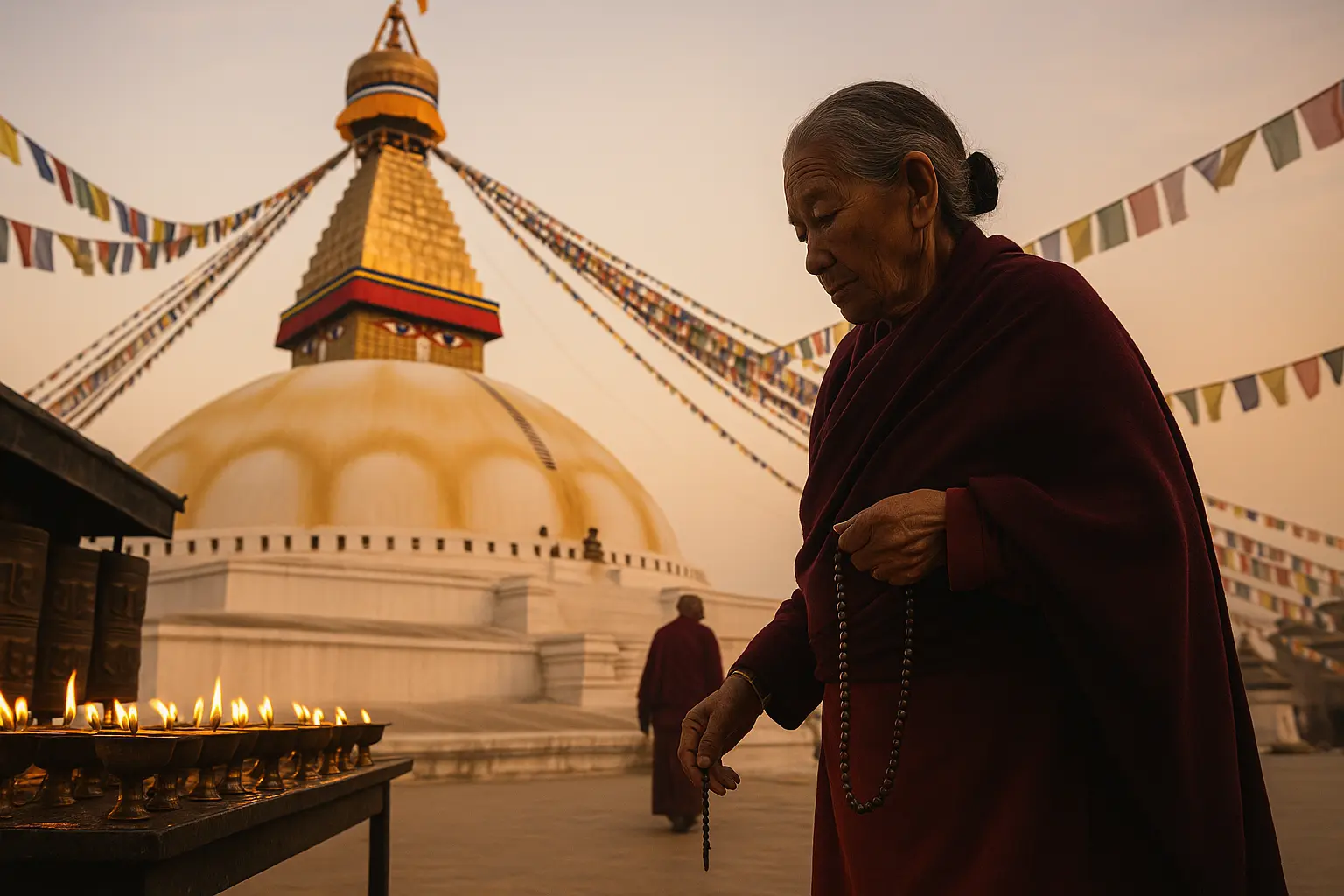
It was just after sunrise in Boudha. The first butter lamps were flickering to life, glowing amber against the white of the stupa. Wind tugged gently at rows of prayer flags above, carrying blessings across the rooftops. A nun passed quietly, her hands on a worn mala, her gaze steady.
This wasn’t a show. It was devotion. Alive, quiet, and deeply human.

Many visitors to Boudhanath are drawn in by the beauty, the colors, and the rituals. But behind every fluttering flag and glowing lamp is a prayer, a teaching, a tradition lived for generations. This is a guide for those who want to see deeper, to feel what these sacred symbols truly mean.

What Are Tibetan Prayer Flags?

Prayer flags, or Lungta (རླུང་རྟ་), are more than decoration. They are wind-borne prayers, rooted in Tibetan Buddhism and even older Bon traditions.

There are five colors, each representing an element:
• Blue, Sky/space
• White, Air/wind
• Red, Fire
• Green, Water
• Yellow, Earth

Each flag is printed with mantras, usually Om Mani Padme Hum, and sacred symbols like the Wind Horse, which carries prayers to the heavens. As the wind passes through the cloth, the prayers are believed to bless all beings.

Prayer flags are not meant to be permanent. They fade, tear, and return to the earth, a reminder of impermanence. New flags are often hung on full moon days or during festivals like Losar (Tibetan New Year).

Why Are Prayer Flags Hung at Boudha and Other Stupas?

Boudhanath, one of the most important Tibetan Buddhist stupas in the world, is crowned with thousands of prayer flags. They stretch in geometric webs from the stupa’s peak to its base, dancing constantly in the breeze.

Hanging flags here is both an offering and a declaration. You’re adding your intentions to a collective prayer. The wind becomes your messenger.

Pilgrims often hang their own strings of flags before a long journey, after a family blessing, or in memory of a loved one. It’s not just what they mean, it’s what they carry.

The Deeper Meaning of Butter Lamps

To offer a butter lamp in Tibetan Buddhism is to offer light, both literal and symbolic.

The butter lamp (marme) represents the light of wisdom, cutting through the darkness of ignorance. In Himalayan monasteries, these lamps are offered daily during morning and evening pujas.

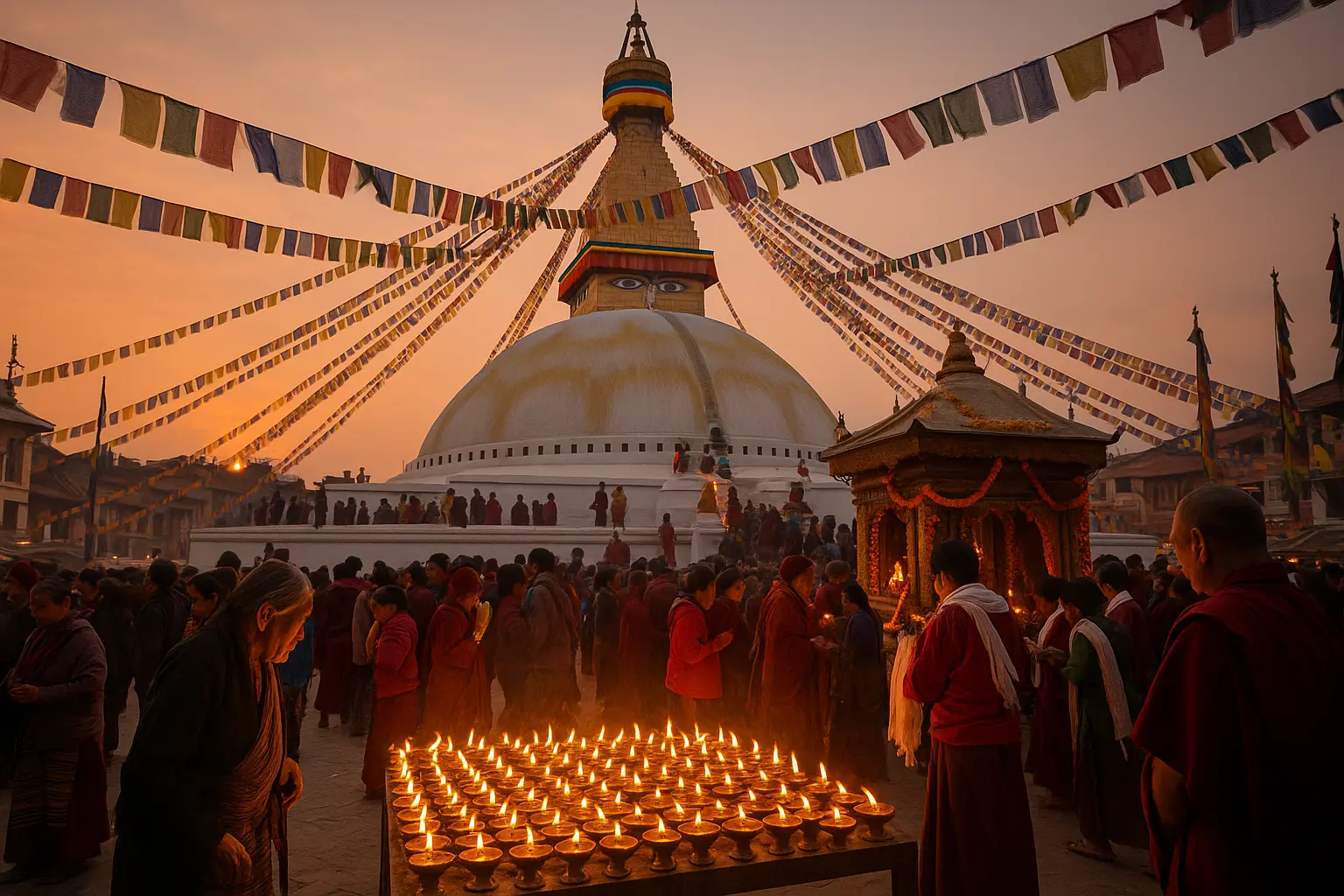
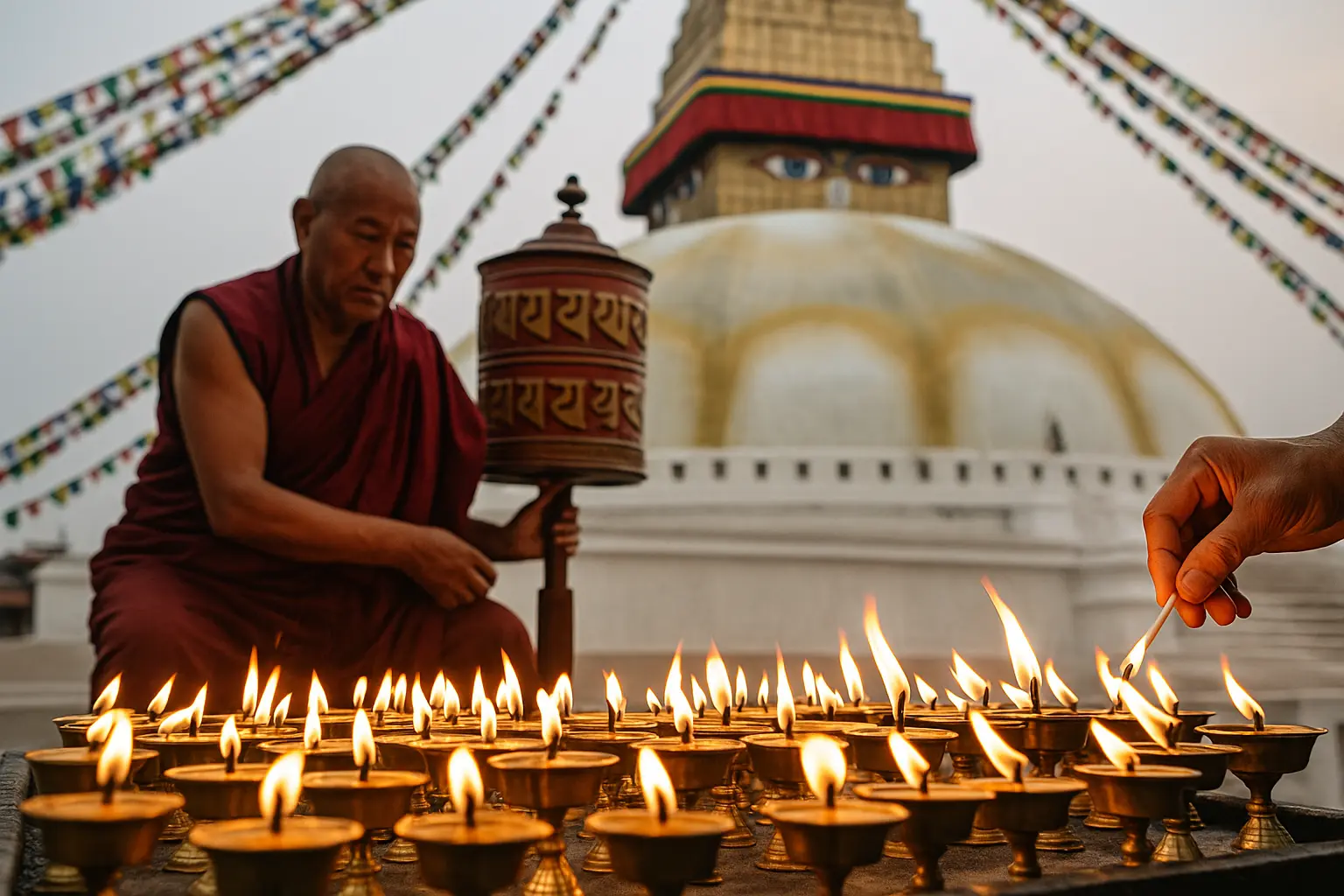
They’re traditionally made with yak butter, but now many use ghee or oil. You can see rows of lamps flickering around the base of Boudha Stupa, especially during dusk.

When you light a lamp with quiet intention, it becomes a prayer, for clarity, for healing, for someone who has passed.

According to Tibetan belief, offering lamps accumulates merit, especially when done with mindfulness. In some traditions, people offer 108 lamps at once, one for each delusion or obstacle in the mind.

Rituals You’ll See in Boudha (and What They Mean)

The stupa isn’t just surrounded by people, it’s circled by devotion. Each act you see has meaning:

Kora: Walking clockwise around the stupa, spinning prayer wheels, reciting mantras. It’s a moving meditation.

Prostration: A full-body bow done repeatedly, often for hundreds of cycles. It’s a physical expression of humility and purification.

Chanting: The most common mantra is Om Mani Padme Hum, associated with Avalokiteshvara, the bodhisattva of compassion.

Mala Beads: 108-bead strands used to count recitations of mantras. Each cycle is a journey inward.

All of these practices invite a slowing down, a shift from thinking to being.

How to Participate (or Observe) Respectfully

Whether you’re a pilgrim or a curious traveler, the key is presence and humility.

  • Walk clockwise around stupas. Never against the flow.
  • Speak quietly. Treat the space like a living temple.
  • Dress modestly. Shoulders and knees covered is appreciated.
  • Avoid selfies during rituals. It disrupts both the moment and the meaning.
  • Buy prayer flags and lamps from monasteries or pilgrims. It keeps the intention clean, and supports the local spiritual economy.

Remember: you’re entering a sacred rhythm. Step lightly.

Staying Close to the Ritual

Living near Boudha, even for a few days, gives you something deeper than a visit. You begin to feel the timing of the rituals, the rhythm of the kora, the quiet before the morning pujas.

From the rooftop of Boudha Mandala Hotel, just 10 seconds from the stupa, you can see the flags unfurl, the lamps begin to glow, and the circle form again.

Whether you’re on a pilgrimage, writing a book, or simply needing stillness, this proximity brings you into the mandala of daily devotion.

Personal Reflection: One Morning Under the Flags

I once lit a butter lamp for someone I had lost. I didn’t know the prayers. I didn’t know the rituals. But I stood beside an old nun who nodded at me, as if saying, “You’re doing it right”.

She lit her lamp with trembling hands, and I followed. There was no language between us. But there was a connection.
That’s the thing about Tibetan rituals. You don’t always need to understand them to feel their truth.

Conclusion
Whether it’s a flag flapping in the wind or a flame dancing in stillness, these symbols stay with you. Tibetan rituals aren’t just things you see; they’re invitations to return to presence, to compassion, to light.

When you leave Boudha, you might not carry a prayer wheel or a mala. But the prayer stays, in how you walk, how you see, how you listen.

How to Do a Kora Around Boudha Stupa (Respectfully)

Key Takeaways
Kora around Boudhanath Stupa is a meditative ritual rooted in Tibetan Buddhist tradition. It involves circumambulating the stupa clockwise while spinning prayer wheels, chanting quietly, and walking with full presence. To do it respectfully, one must dress modestly, avoid loud speech or intrusive photography, and observe the behavior of locals. The early morning and dusk are ideal times to experience the stillness and devotion this practice embodies. More than a ritual, kora is a quiet act of connection to yourself, the community, and something timeless.

Introduction
You arrive in Boudha and pause at the entrance of the kora path. Around you, the stupa rises with gentle power, prayer flags flicker above, and the hum of spinning wheels wraps the space in a sacred rhythm. No one tells you what to do, yet something in you understands: walk, slowly, clockwise, with care.

Kora at Boudhanath is a silent invitation to join a centuries-old practice of healing, devotion, and inner stillness. This guide shares how to do a kora respectfully and meaningfully, whether you’re a first-time visitor or a spiritual seeker.

What is Kora and Why It Matter

In Tibetan Buddhism, kora (བསྐོར་བ་) means circumambulation, walking clockwise around a sacred site like a stupa, temple, or monastery while focusing on mantras or intentions. Each step is part of a prayer. Each round is an offering.

At Boudhanath, this act isn’t symbolic. It’s lived. Elders walk dozens of koras a day. Nuns with malas chant under their breath. Children learn the flow of clockwise footsteps early.

Kora is believed to purify negative karma, accumulate merit, and stabilize the mind. It’s meditation in movement.

When to Do Kora at Boudhanath

The beauty of Boudha is that it never sleeps. The kora path is alive from sunrise to well after dusk, but these are the most resonant times:

Early Morning (5:30 to 7:00 am): The stillness is almost otherworldly. Monks chant, the light is golden, and local practitioners begin their day in quiet rhythm.

Dusk (5:00 to 7:00 pm): Butter lamps are lit. The stupa glows. It’s the most emotionally powerful time to join the circle.

On Holy Days: During festivals like Lhabab Duchen or Buddha Jayanti, thousands of people move in prayerful silence. The atmosphere is electrifying.

How to Do Kora with Respect

If you’re new, start by watching. Observe the body language, pace, and gestures of those around you. Then, join in with humility.

Walk Clockwise: Always circle the stupa in a clockwise direction, keeping it to your right.

Spin Prayer Wheels Gently: Use your right hand, moving each wheel as you pass. It’s not about speed.
Keep a Peaceful Pace: Walk slowly and mindfully. This isn’t a hike, it’s sacred ground.

Dress Modestly: Cover shoulders and knees. Avoid flashy outfits.

Stay Quiet: Speak softly or not at all. Listen to the space. Let silence guide you.

Avoid Photography Mid-Kora: Don’t snap selfies while walking. It disrupts the atmosphere.

Offer a Lamp or Prayer: You can light a butter lamp before or after your walk, or recite the mantra Om Mani Padme Hum.

What You’ll Notice Along the Path

Kora isn’t just a motion. It’s full of presence. As you walk, the scent of juniper incense follows you. Pigeons flap overhead, settling and lifting like breath. The low murmur of prayers creates an unbroken sound current. Children walk with grandparents, passing this ritual down gently.

There’s something deeply human about this circle. You are alone, yet surrounded. Anonymous, yet connected.

Common Mistakes to Avoid

Even well-meaning visitors sometimes misstep. Here’s what to be mindful of:

  • Don’t walk against the flow , it disturbs the energy and practice.
  • Don’t interrupt others , especially those prostrating or praying intently.
  • Don’t touch monks or nuns , respect their boundaries.
  • Don’t point feet at the stupa , in Buddhist etiquette, feet are seen as unclean.
  • Don’t treat it like a spectacle , Boudha is not a performance. It’s devotion in motion.

Deepen the Experience: Stay Nearby

To truly understand kora, stay in Boudha for a few days. The rhythm sinks in. You begin to notice the same faces each day, quietly circling. The shifting sky above the dome. Your own breath syncing with the flow.

Boudha Mandala Hotel, just 10 seconds from the stupa, is ideal for this. You can step into the circle before dawn, return for tea, and feel part of the sacred village life.

Final Reflection
One morning, I passed a man in his 70s, eyes half-closed, mala beads worn smooth. He walked barefoot, one hand on the prayer wheel, the other resting gently on his chest.

We didn’t speak. But for a moment, our pace aligned. It felt like a transmission, not of words, but of presence.

That’s what Kora offers. Not just movement, but meaning.
In this sacred circle, you don’t just walk around the stupa, the stupa walks you.

What to Expect When Visiting Boudha Stupa

Key Takeaways
Boudhanath Stupa in Kathmandu is a sacred site where Tibetan Buddhist rituals and daily life blend into one peaceful rhythm. When visiting, expect to walk clockwise in kora, spin prayer wheels, light butter lamps, and witness monks chanting in nearby monasteries. The air smells like incense and juniper, and the best times to go are early morning or at dusk. Whether you’re a pilgrim or curious traveler, Boudha offers a rare sense of stillness and spiritual presence.

Introduction
There’s a moment when you first arrive at Boudhanath that stays with you forever. You leave the noise of Kathmandu’s traffic behind and step into a quiet, sacred circle. The giant white dome rises in front of you, wrapped in a constant flow of footsteps, mantras, and prayers. Colorful flags stretch across the sky. Monks in maroon robes walk in silence. Pigeons lift and land like wind-borne thoughts.

You’re no longer just a visitor. You’re part of something timeless.

This is what makes Boudha Stupa different. It isn’t a sightseeing stop , it’s a spiritual pulse that still beats, every day, every dusk, every dawn.

1. The Daily Rhythm of Boudhanath

Boudha lives in cycles. From morning prostrations to evening butter lamps, there’s a rhythm you’ll feel just by being present.

– Kora: Locals and pilgrims walk clockwise around the stupa, spinning prayer wheels as they pass. Many hold mala beads, softly reciting Om Mani Padme Hum.

– Butter Lamp Offerings: Along the base of the stupa, you’ll find small platforms where butter lamps flicker in the wind. Each flame is a prayer, a light for someone’s path.

– Prostrations: You’ll see devoted practitioners stretch flat to the ground in full-body bows, especially early morning. It’s humbling to witness.

– Monastery Chants: Listen carefully, some sounds come from inside nearby monasteries. Morning pujas, conch shells, chanting. The whole neighborhood breathes in unison.

No matter when you visit, the stupa is always alive.

2. Sights, Sounds, and Scents: What You’ll Feel

Boudha isn’t just something you see , it’s something you feel with every sense.

– Eyes: The all-seeing eyes of the Buddha gaze out in every direction. Golden spires shine in the sun. Prayer flags flutter like messages on the wind.

– Ears: Bells ring gently. Monks chant from hidden gompas. Footsteps pat the brick path. Sometimes, there’s a silence so deep it feels sacred.

– Nose: The smell of incense and juniper is everywhere. Butter from lamps. Flowers laid gently at shrines.

Many visitors say Boudha is the only place in Kathmandu where they immediately feel peace.

3. Best Time to Visit Boudha Stupa

You can visit Boudha any time of day, but here’s what makes each moment special:

– Dawn (5:30–7:00 am): Monks start morning pujas. The air is cool. Serious practitioners begin their prostrations. The light is soft and golden.

– Late Morning to Afternoon: More cafes open. Good for photography. Busier, but still calm.

– Dusk (5:00–7:00 pm): Butter lamps are lit. The kora path fills. The sky glows. For many, this is the most moving time of day.

Bonus: Visit during a festival.

– Losar (Tibetan New Year): Joyful chaos, color, and celebration

– Buddha Jayanti: A sacred full-moon event
Lhabab Duchen: Celebrates Buddha’s descent from heaven

During these days, the stupa becomes a full mandala of activity.

4. How to Participate Respectfully

Boudha is not a tourist attraction; it’s a living shrine. Here’s how to walk with care:

– Walk clockwise: Always. Never go the other way.

– Dress modestly: Shoulders and knees covered is best. Scarves are common.

– Speak softly: The stupa is sacred to many. Keep voices low.
Don’t point feet at shrines or monks: It’s considered disrespectful.

– Photography: Allowed, but not during rituals or in people’s faces. If unsure, ask.

– Offer a butter lamp: You can light one with quiet intention. It’s simple, beautiful, and meaningful.

5. Where to Pause and Reflect

Boudha isn’t just for walking. It’s also for sitting. Watching. Breathing.

– Rooftop cafés: Order a butter tea or masala chai, and just sit. Let the stupa unfold below you.

– Hidden benches: Tucked along the kora path, these are perfect for journaling or quiet prayer.

– Monastery courtyards: Some are open during the day. Step in. Remove your shoes. Feel the stillness.

If you’re in a rush, you’ll miss what Boudha is offering. The slower you go, the deeper it feels.

6. Staying Nearby: Deepening the Experience

If you stay overnight in Boudha, the experience becomes something else entirely.

– You’ll hear the first bells at dawn from your window.

– You can join kora before sunrise and feel like a local.

– You’ll find hidden cafes, quiet gompas, rooftop meditations that you miss if you only visit once.

If you’re seeking retreat, purpose, or just quiet to work , Boudha is ideal.

If you’re looking for a peaceful hotel just steps from the stupa, Boudha Mandala Hotel offers stupa-view rooms, long-stay options, and a warm local welcome.

7. Personal Reflection: My Most Unexpected Moment

One morning, while walking in the soft light, I saw an old Tibetan woman walking clockwise in complete silence. Her back was bent. Her mala moved slowly in her hands. As I passed her, she whispered, barely audibly, “Om Mani Padme Hum.”

She had probably walked this circle thousands of times. Yet, each step was fresh, prayerful. It reminded me, spiritual places don’t shout. They whisper.

Conclusion
Visiting Boudha isn’t about ticking a box. It’s about slowing down long enough to feel something sacred.

You’ll leave with incense on your clothes, a stillness in your chest, and a quiet knowing that something real still exists in this world.

If you can, stay close. Let Boudha become part of your rhythm. Boudha Mandala Hotel can be your spiritual home just seconds away.

The History of Boudha: Why It’s One of the Holiest Places in Tibetan Buddhism

Key Takeaways
Boudhanath Stupa in Kathmandu is one of the holiest Buddhist sites in the world and the heart of Tibetan Buddhism in Nepal. Rooted in ancient legends and built during the Licchavi period, it has grown from a simple act of devotion to a sacred monument that holds relics, prayers, and generations of seekers.

After the 1959 Tibetan diaspora, Boudha became a refuge and spiritual center, now surrounded by dozens of monasteries. More than history, Boudha is a living shrine of resilience, faith, and inner peace.

Introduction
When you walk through the narrow lanes of Boudha and suddenly emerge into the vast circle of sky and stupa, something shifts. The pace of life slows. The air smells like juniper and melted butter. Prayer wheels spin in sync with ancient mantras. And at the center, like a spiritual compass, stands the towering white dome of Boudhanath Stupa.

This isn’t just a monument. It’s a witness to centuries. A sacred pulse in the middle of Kathmandu. Its story is woven with myth, migration, ritual, and quiet resilience. To know Boudha is to understand why the spiritual heartbeat of Tibetan Buddhism continues to echo from this place.

The Legend of a Poultry Keeper: The Mythical Origin

According to Buddhist legend, Boudhanath was built by a humble poultry-keeping woman and her four sons. Moved by faith, she petitioned the king for a small piece of land to build a shrine for the relics of Kassapa Buddha. The king granted her wish, and with love, devotion, and the help of her sons, she constructed what became one of the greatest stupas of the Buddhist world.

This legend continues to live in the local consciousness, a reminder that deep faith, even from someone seen as ordinary, can create something timeless and holy. The stupa is more than a structure; it’s a monument to the power of intention.

Historical Foundations: Licchavi Period and Early Buddhism

Beyond the myth, historical evidence places the construction of Boudhanath during the Licchavi era, around the 5th to 6th century CE. In ancient texts, the stupa was known as Khasti Chaitya , with “Khasti” meaning “dew.” During a long drought, locals are said to have cultivated the land with collected dew to support the construction.

This was a time when Nepal was a vital center of Buddhist learning and trade between India and Tibet. Boudhanath became a sacred stop on early pilgrimage routes. It was, and remains, a powerful representation of the dharma in stone.

A New Chapter: The Tibetan Refugee Era Post-1959

The year 1959 marked a profound transformation for Boudha. After the Chinese invasion of Tibet, thousands of Tibetan refugees crossed the Himalayas and settled in the Boudha area. The stupa, already sacred, became a new spiritual home for a displaced people.

Dozens of Tibetan Buddhist monasteries, including Shechen Monastery, Ka-Nying Shedrub Ling, and Thrangu Tashi Yangtse, were built around the stupa. Each lineage, from Nyingma to Gelug, found space here. The stupa became more than a historical site. It became a living monastery, a center for ritual, community, and the continuation of a threatened tradition.

Even today, Boudha is one of the only places outside Tibet where Tibetan Buddhism thrives so openly and fully.

Boudhanath as a UNESCO World Heritage Site

In 1979, UNESCO declared Boudhanath a World Heritage Site, not just for its architecture, but for its cultural and spiritual value. The stupa is one of the largest spherical stupas in the world. Its design follows a mandala pattern, representing the universe, with the dome symbolizing emptiness, and the 13 spires representing stages toward enlightenment.

After the 2015 earthquake, the stupa suffered significant damage. But the restoration that followed, funded by local monasteries and global Buddhist communities, became a symbol of collective healing and resilience.

Spiritual Importance in Tibetan Vajrayana Practice

Boudhanath isn’t just sacred because of history , it is sacred because of what happens there every single day.

– Circumambulation (kora): Devotees walk clockwise around the stupa while reciting mantras.

– Butter lamp offerings: Symbolic acts of light and wisdom

– Prayer flags: Sending compassion to all directions

– Prostrations: Practiced with full-body devotion, especially during dawn and dusk

It’s believed that walking the kora mindfully purifies lifetimes of karma. For Vajrayana practitioners, Boudha is a place where the veil between seen and unseen feels especially thin.

Festivals and Ritual Rhythms at the Stupa

Some of the most powerful experiences at Boudha come during major Tibetan and Buddhist festivals:


– Losar: Tibetan New Year marked with music, prayer, and color

– Buddha Jayanti: Celebrating the Buddha’s birth, enlightenment, and passing

– Lhabab Duchen: Honoring the Buddha’s return from heavenly realms

These aren’t tourist events. They are living rituals, participated in by monks, nuns, and families. Butter lamps line the base of the stupa. Chanting fills the air. It is devotion in motion.

A Living Pilgrimage Site: Why Boudha Still Matters

In a fast-moving world, Boudhanath remains a place where the sacred slows you down. For many Tibetans and Himalayan Buddhists, visiting Boudha at least once is a lifetime goal. For others, it becomes a daily rhythm , a morning kora, an evening lamp. The stupa radiates peace not only because of its design, but because of the countless acts of devotion offered here for over 1500 years. It is a center of collective consciousness, a space for refuge, remembrance, and recommitment to the path.

Reflection: The Wisdom Hidden in the Stones

I remember sitting on a rooftop café one dusky evening, sipping salt-butter tea while watching hundreds of butter lamps flicker around the stupa. An old monk passed by below, spinning a prayer wheel slowly. Children chased pigeons. Somewhere, a bell rang.

In that moment, I felt what many before me have felt: Boudha is not just a place you visit. It is a place that visits something inside you.

Conclusion
The history of Boudha is not written in dry records; it is carried in footsteps, lit in butter lamps, and whispered through mantras. From the humble prayer of a poultry keeper to the resilience of an exiled community, Boudha teaches us that the sacred is not fixed in stone, but renewed with every offering.

To walk around Boudhanath is to walk with history, with spirit, and with generations of hope.

If you wish to stay immersed in the peaceful rhythm of this sacred place, Boudha Mandala Hotel offers spiritually aligned rooms just 10 seconds from the stupa, a perfect base for slow travel, retreat, and reflection.

What is Boudhanath Stupa? The Spiritual Heart of Kathmandu

Key Takeaway

Boudhanath Stupa is one of the most sacred Buddhist sites in Nepal, located in Kathmandu. This immense white dome, adorned with the all-seeing eyes of the Buddha, is a pilgrimage site, a spiritual hub, and a place of daily prayer for Tibetan Buddhists and Himalayan communities. It’s where ancient traditions meet modern life, creating a peaceful yet powerful atmosphere of devotion, stillness, and cultural richness.

Introduction

When you first step into Boudha, there is a moment,a hush. The sound of traffic softens. The air feels different. Prayer flags flutter like silent whispers across the sky. And at the center of it all stands the immense white dome of Boudhanath Stupa, like the heart of the valley itself.

For many, Boudhanath isn’t just a sacred site. It’s a place to return to. To walk in circles. To light a lamp. To breathe. It’s where monks chant, pilgrims prostrate, and seekers pause between journeys. Whether you come for peace, practice, or photography, Boudha welcomes you with presence.

What Is Boudhanath Stupa?

Boudhanath Stupa (also spelled Bouddhanath or Boudha) is one of the largest spherical stupas in the world and arguably the most important Tibetan Buddhist site outside of Tibet. Located in Kathmandu, it is both a spiritual magnet and a daily place of practice.

The structure itself is rich with symbolism:

– A massive white dome symbolizing the vastness of the universe

– The harmika and the 13-tiered spire representing the stages of enlightenment

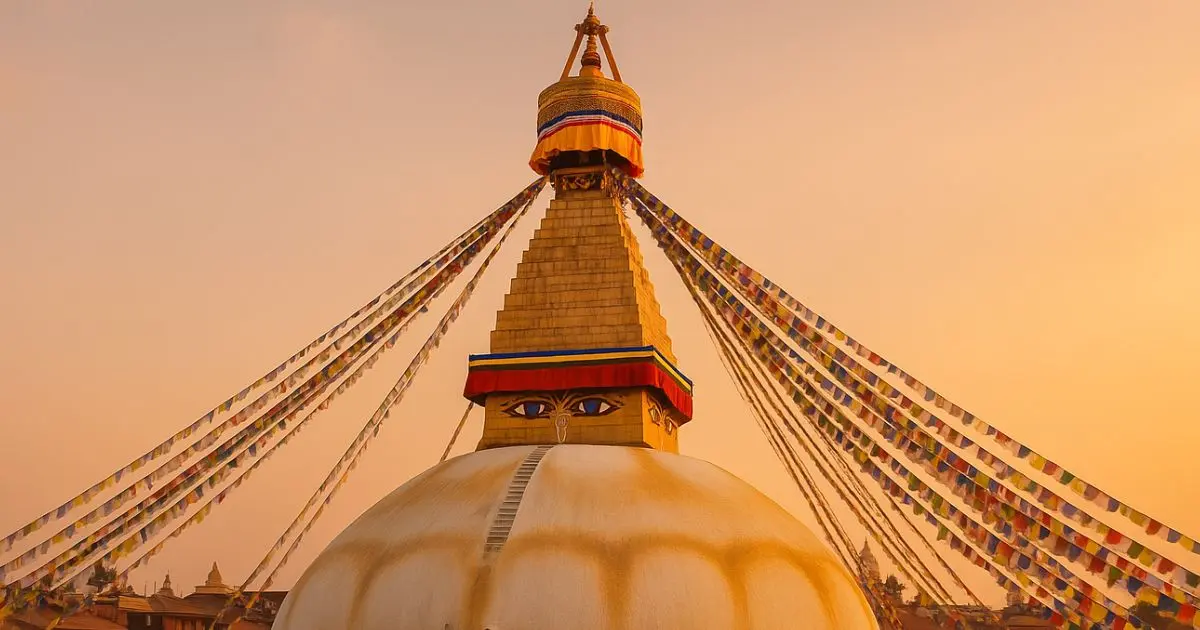
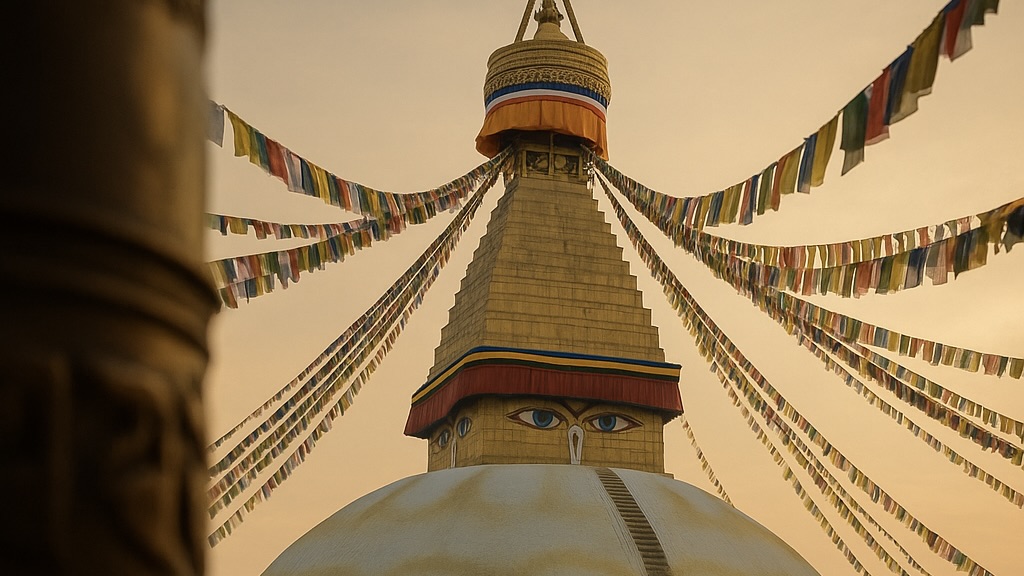
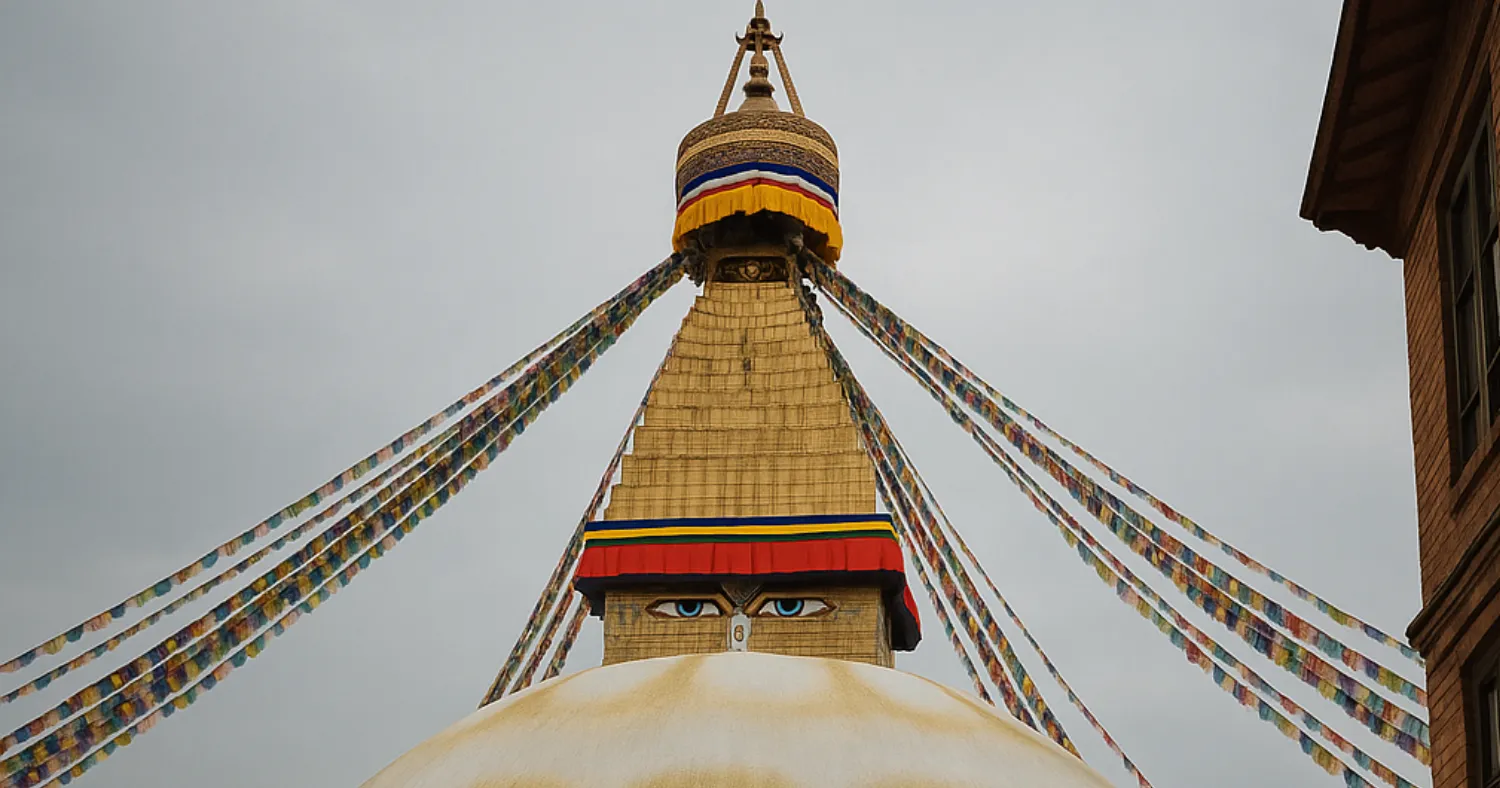
– The Buddha’s eyes painted on all four sides, watching in compassion

– The base ringed with prayer wheels and mandalas, inviting movement and meditation

– It is not just a monument. It is a living, breathing site of devotion.

Historical Origins of Boudhanath

The origins of Boudhanath are wrapped in both legend and historical record. According to local myth, the stupa was built by an old woman who asked the king for permission to construct a shrine to enshrine the relics of Kassapa Buddha. Her devotion was so deep that even the king granted her land.

Historically, the stupa dates back to the Licchavi period, likely built in the 5th century CE. After the 1959 Chinese invasion of Tibet, thousands of Tibetan refugees settled in Boudha, turning it into the epicenter of Tibetan culture in Nepal.

In 1979, UNESCO recognized Boudhanath as a World Heritage Site, cementing its global spiritual and cultural importance.

Spiritual Significance: The Soul of Tibetan Buddhism in Nepal

For Vajrayana Buddhists, Boudhanath holds immense spiritual power.

It is said that circumambulating the stupa with a pure heart accumulates merit and purifies negative karma.

Around the stupa are over 50 Tibetan monasteries, many of them built after the Tibetan diaspora. Monks, nuns, lamas, and lay practitioners all engage in daily rituals:

– Kora (circumambulation): Always done clockwise, often with mala beads

– Offering butter lamps: A symbolic act of lighting the path to wisdom

– Hanging prayer flags: Sending blessings across space and wind

– Prostrations: Seen early in the morning and late in the evening, with deep reverence

Boudhanath is not just about belief,it’s about spiritual practice lived daily.

What to Expect When You Visit

Visiting Boudhanath is an experience that touches all senses:

– Sounds: Tibetan horns, chants, bells, and soft footsteps

– Scents: Incense, juniper, butter lamps

– Sights: Golden spires, maroon-robed monks, spinning prayer wheels

– Feeling: A deep, palpable calm

You can join the kora, sit on a rooftop cafe with a view, or simply observe. Vendors around the stupa sell thangka paintings, prayer beads, butter lamps, and ceremonial items. But unlike many tourist sites, the spiritual atmosphere stays intact.
At dawn and dusk, the stupa glows. Pilgrims arrive in hundreds, walking quietly or whispering mantras. The whole space feels like a mandala in motion.

Best Time to Visit Boudhanath

Time of Day:

– Sunrise: Ideal for quiet photography and observing morning prostrations

– Sunset: When butter lamps light the kora path and chants echo across the dome

Festivals:

– Losar (Tibetan New Year): Colorful, crowded, and deeply devotional

– Buddha Jayanti: Commemorating Buddha’s birth, enlightenment, and parinirvana

– Lhabab Duchen: Celebrating Buddha’s descent from heaven

Each festival fills Boudha with vibrant energy, but also reverent discipline.

How to Visit with Respect and Awareness

– Dress Modestly: Cover shoulders and knees

– Walk Clockwise: When circumambulating the stupa, always go clockwise

– No Loud Talking or Music: It’s a space for reverence

– Photography: Allowed, but not during rituals or too close to monks

– Participate Gently: Light a butter lamp or spin a prayer wheel with intention

Remember, Boudhanath is not a museum. It’s a sacred site still lived in and loved.

Staying Near the Stupa: A Spiritual Base for Slow Travel

Staying in Boudha allows you to experience the rhythm of stupa life:

– Morning kora with locals

– Afternoons reading in peaceful courtyards

– Evenings watching monks light lamps

For long-stay travelers, retreat-goers, or digital nomads seeking peace, it’s an ideal alternative to Thamel. You’ll find vegetarian cafes, organic bakeries, yoga spaces, and hidden gompas just steps away.

If you’re looking for a peaceful, spiritually aligned place to stay, Boudha Mandala Hotel offers stupa-view rooms, a calming rooftop, and long-stay comfort just 10 seconds from the stupa.

Personal Reflections: A Place That Changes You

I came to Boudhanath thinking I would see something. But I left having felt something.

Maybe it was the rhythm of the footsteps around the stupa. Maybe it was the silence inside the monastery. Maybe it was a little old woman, eyes closed, whispering Om Mani Padme Hum like a prayer to the sky.

Conclusion
Boudhanath is more than bricks, more than relics, more than tradition. It is a space of remembering. Of turning inward while walking outward. Of realizing that sometimes, the sacred isn’t something you find, but something you return to.

When you walk around Boudhanath, you don’t walk alone. You walk with centuries of seekers, saints, and silent prayers.
And when you leave, part of you stays.

Make your journey to Boudha deeper by staying close. Boudha Mandala Hotel is a spiritually aligned boutique hotel just steps from the stupa,perfect for retreat, reflection, or mindful work.

What Buddhist Festivals Are Celebrated at Boudhanath?

If you’re planning to visit Boudhanath, don’t just come for the view, come for the feeling. The festivals celebrated here are not tourist spectacles; they are sacred, vibrant moments that reveal the beating heart of Tibetan Buddhist life in Nepal. Walk the kora during Losar and you’ll feel it: incense in the air, chants echoing from monastery walls, every step soaked in centuries of devotion.

This guide offers a clear, heartfelt path to experiencing the most important Buddhist festivals at Boudhanath and how you can witness them meaningfully.

Key Takeaways:

If you want to experience the living heart of Buddhist culture in Kathmandu, time your visit to Boudhanath during a local festival. From the vibrant colors of Losar to the quiet devotion of Gunla, each celebration offers a window into centuries-old traditions and the deep spirituality that surrounds the stupa. Come not just to watch, but to listen, learn, and feel the pulse of this sacred place.

The Magic of Boudhanath During Festival Season

I still remember my first Losar at Boudhanath. The air smelled like juniper smoke. The stupa shimmered with rows of butter lamps, each flame flickering a silent prayer. Children darted between pilgrims. Monks chanted late into the night. It wasn’t just beautiful, it was deeply moving.
Festivals at Boudhanath aren’t tourist events. They’re living rituals that shape the rhythm of the community. They mark time, honor ancestors, call blessings, and bring people together. If you’re planning a visit to Boudha, aligning it with one of these festivals can turn your stay into something unforgettable.

1. Losar (Tibetan New Year)

  • When: Usually February or March, depending on the lunar calendar

– Why It Matters: Losar is the most important festival in Tibetan Buddhism. It marks the beginning of a new year, and with it, a deep spiritual reset.

During Losar, Boudhanath becomes a vibrant sea of color, movement, and sound. Monks perform traditional Cham dances in the monasteries. Families clean their homes and offer khatas (white scarves) at the stupa. Butter lamps are lit by the thousands, sending prayers into the coming year.

Local Tip: Arrive early on the main day to witness monks at Shechen Monastery perform the intricate Vajrakilaya rituals.

2. Buddha Jayanti (Buddha Purnima)

– When: Full moon of Baisakh (April–May)

– Why It Matters: This day celebrates the birth, enlightenment, and parinirvana (passing) of the Buddha, all in one.

At Boudhanath, thousands gather to offer prayers, chant sutras, and circumambulate the stupa in silence and reverence. It’s one of the most peaceful yet powerful days of the year.

I once watched a young boy offer a single marigold with both hands, eyes closed in sincerity. That tiny moment said more than any ceremony could.

3. Gunla (Sacred Month for Newar Buddhists)

– When: August–September

– Why It Matters: Gunla is a month-long devotional period where Newar Buddhists walk to Boudha from different parts of the valley, often at dawn, playing traditional Gunla Bajan music.

The atmosphere is rich with the sound of dhime drums and long flutes. Sacred art and scriptures are displayed publicly, and daily rituals intensify in monasteries.

Don’t Miss: The morning processions. They’re humble, musical, and deeply rooted in local devotion.

4. Mamla Jatra

– When: Full moon of Magh (January–February)

Why It Matters: Unique to the Boudha area, this jatra (festival) honors Mamo Pukasi, a protective deity. A chariot procession encircles the stupa, invoking her blessings.

You’ll see offerings made in every corner, rice, flowers, and torma (ritual cakes). There’s a quiet sense of protection woven through the day.

5. Chechyu Puja (Guru Rinpoche Day)

– When: 10th day of each lunar month; major celebration in January

– Why It Matters: This puja honors Padmasambhava (Guru Rinpoche), who brought Vajrayana Buddhism to Tibet. It’s especially important to the Nyingma school.

Monks chant long-form texts like the Seven-Line Prayer. Butter sculptures and torma are created. Laypeople offer kataks and seek blessings.
Reflection: During one Chechyu, I sat for hours just watching an elder repeat his mantra bead by bead. He wasn’t performing. He was communing.

6. Tamu Lhosar (Gurung New Year)

– When: December–January

– Why It Matters: Though not traditionally Tibetan, Tamu Lhosar is celebrated widely at Boudhanath by the Gurung community, who are also Buddhists.

Expect lively processions, traditional dress, and flag hoisting at the stupa. It’s a joyful, family-centered celebration.

How to Experience These Festivals Respectfully

If you’re visiting Boudhanath during any of these festivals, remember:
Dress modestly. Cover shoulders and legs.

– Don’t point your feet at monks, statues, or shrines.

– Always walk clockwise around the stupa.

– Ask before taking photos, especially during rituals.

– Consider lighting a butter lamp with a prayer or intention.

Locals will welcome your presence if you arrive with humility.

Final Thought

Boudhanath isn’t just a place; it’s a living mandala of community, devotion, and rhythm. When you witness its festivals, you’re stepping into an ancient story that’s still unfolding today.

And if you’re looking for a peaceful space just steps from the stupa, Boudha Mandala Hotel offers a warm, quiet retreat where you can experience these moments with intention and comfort.

How to Experience Authentic Local Culture in Boudha: A Mindful Traveler’s Guide

Key Takeaways

If you’re looking to experience the real Boudha, not just see it, immerse yourself in local life. Walk the morning kora alongside Tibetan grandmothers. Light a butter lamp with intention. Taste fresh thukpa made by families who’ve lived here for generations. True cultural immersion in Boudha begins when you slow down, listen deeply, and let the stupa’s rhythm shape your days.

Arriving in Boudha: First Impressions That Stay With You

The first time I stepped into Boudha, it wasn’t the scale of the stupa that struck me. It was the sound. The deep, low hum of mantras swirling in the air, carried by pilgrims circling clockwise in quiet devotion. Prayer wheels turned with well-worn palms. Butter lamps flickered along the stupa’s base. Something about it all, so ordinary, so sacred, made me want to stay.

Unlike Thamel’s tourist energy, Boudha feels slower, rooted, and protective. It’s not performative culture; it’s lived culture. To truly experience it, you have to meet Boudha on its terms.

1. Start with the Kora: The Spiritual Pulse of Boudha

Every morning and evening, the local community walks the kora, the clockwise circuit around the stupa. Some carry prayer beads, others walk in silence. Some whisper mantras, others listen.

Join them, not as a spectator, but as a fellow traveler. Walk slowly. Notice the rhythm. Spin the prayer wheels if it feels right. Don’t rush. This isn’t a performance, it’s a spiritual practice, and being part of it, even quietly, is the first step toward understanding Boudha.

Tip: Arrive around 6:00 AM. The first light over the stupa, mixed with soft chanting and the smell of incense, is unforgettable.

2. Visit the Monasteries, But Stay for the Moments

Boudha is home to dozens of monasteries representing different schools of Tibetan Buddhism. You can visit the grand Shechen Monastery with its vivid murals or the tucked-away Ka-Nying Shedrub Ling Monastery near the east gate.

But the real moments? They’re often unplanned:

– Sitting quietly during a prayer session and feeling the chants resonate through your chest.

– Watching young monks laugh as they sweep the courtyard.

– Lighting a butter lamp in memory of someone you love.

You don’t need to understand the rituals. Just be present.

3. Eat Where the Locals Eat: A Taste of Tibetan-Nepali Life

Food is a powerful entry point into any culture, and in Boudha, it’s deeply comforting. Skip the Western cafés (though there are good ones) and try the spots hidden in alleyways where aunties serve steaming bowls of thukpa and hand-folded momos.

Some favorites:

– Tsangpo Restaurant – homestyle Tibetan dishes in a no-frills setting.

– La Casita de Boudhanath – rooftop views with a mix of Nepali and Spanish-inspired dishes.

– Stupa View Cafe – a peaceful spot for butter tea or lemon ginger honey.

Groceries are also a cultural experience here. Walk through Boudha’s Saturday organic market to find local honey, buckwheat, or handmade incense.

4. Learn the Language of Butter Lamps and Prayer Flags

Culture in Boudha isn’t always spoken. It’s symbolized through offerings, color, gesture, and ritual.

– Butter lamps: Lighting one is an act of remembrance, aspiration, or prayer. You can do this yourself for a small donation at most temples.

– Prayer flags: Each color and mantra has meaning. When strung across rooftops, they bless the winds and the beings they touch.

– Mala beads: Often seen in the hands of older Tibetans walking kora, they aren’t jewelry; they’re spiritual tools.

Ask before photographing these moments. Better yet, participate when appropriate.

5. Shop Mindfully: Support Local Artisans and Keep the Culture Alive

Boudha has its share of souvenir stalls, but look deeper. There are families who’ve painted thangkas for generations, young women learning metalwork from their grandfathers, and shopkeepers who can tell you the story behind each piece.

When you:

– Buy a hand-painted thangka

– Commission a custom mala

– Support an NGO-run handicraft store

…you’re not just shopping. You’re sustaining a living tradition.

Ask how things are made. Be curious. Choose handmade over mass-produced.

6. Participate in a Local Festival or Puja

If you’re in Boudha during Losar (Tibetan New Year) or Buddha Jayanti, don’t just watch, participate. You’ll witness:

– Giant sand mandalas being created, then ritually dissolved.

– Monks chanting for days in preparation.

– Community feasts where you may be warmly invited to sit and eat.

These festivals are vibrant, sacred, and grounded in devotion. Bring an open heart, dress modestly, and ask your host or hotel how to participate respectfully.

7. Stay in a Place That Reflects the Spirit of Boudha

Where you stay shapes how you experience a place. In Boudha, staying at a mindful hotel like Boudha Mandala Hotel means waking up to the stupa’s morning chants, sipping tea on a stupa-view balcony, and being cared for by staff who understand why you came.

The hotel is just 10 seconds from the stupa, close enough to feel its energy, but tucked away enough to offer peace. With multilingual staff, spiritual travelers in mind, and long-stay rooms for remote workers or sabbatical-goers, it supports your inner journey too.

It’s not just a hotel, it’s a gentle space to arrive and belong.

8. Let Boudha Change Your Rhythm

Perhaps the biggest shift when you truly engage with Boudha’s culture is not what you do, but how you do it.
You learn to:

– Walk slower

– Listen more

– Eat without multitasking

– Sit in silence without filling it

Local culture isn’t something to “check off.” It’s something that seeps in when you let go of rushing and lean into presence. Boudha teaches that without words.

Final Reflection

I came to Boudha thinking I’d stay a few days. I stayed three months. Not because there was a checklist of things to do, but because it felt like home in a way few places ever have.

To experience the authentic culture of Boudha, don’t try to consume it. Instead, be in a relationship with it. Walk the stupa path every morning. Make friends with a momo vendor. Sit quietly in a monastery courtyard. Let the prayer flags do their work above you.

If you’re looking for the best stupa view hotel in Boudha, Boudha Mandala offers more than a room; it offers a welcome into the spirit of this place.

When is the Best Time to Visit Boudhanath?


If you want to experience the deeper rhythms of life in Kathmandu, visiting Boudhanath during one of its sacred festivals can feel magical. But when exactly should you go?

The answer depends on what kind of experience you’re seeking: quiet reflection, cultural immersion, or high-energy celebration.

This guide is for spiritual travelers, solo seekers, and remote workers who want more than sightseeing. Here’s everything you need to know about the best time to visit Boudhanath for festivals.

Understanding the Spiritual Calendar at Boudhanath

Boudhanath follows both the Tibetan and Nepali lunar calendars, so festival dates shift each year. However, the seasonal rhythm remains predictable. If you time your visit right, you can witness age-old rituals, masked dances, and butter-lamp ceremonies that offer a window into Tibetan Buddhist life.

The most spiritually significant festivals include:

– Losar (Tibetan New Year) – Feb or March

– Buddha Jayanti (Vesak) – Full moon in May

– Mohani/Dashain – Late September to mid-October

– Tihar (Festival of Lights) – October to early November

– Monthly Full Moon Days (Purnima) – All year round

Spring (March to May): Clear Skies & Sacred Celebrations

Spring is arguably the best time to visit Boudhanath. The sky is clear and the stupa pulses with life during Losar and Buddha Jayanti. Flowers bloom along the kora path, monks chant in the courtyards, and the whole area feels vibrantly awake. Days are comfortably warm (15–25 °C), perfect for long, peaceful walks or outdoor rituals.
Ideal for: Spiritual immersion, mild weather, high-energy rituals.

Festivals: Losar (Feb–Mar), Buddha Jayanti (May).

Travel tip: Book accommodation early, monks and pilgrims arrive in waves.

Autumn (Mid-September to November)

Autumn is another best time to visit Boudhanath, especially for culture lovers. Mohani (Newar Dashain) and Tihar light up the stupa with sword dances, butter lamps, and ancestral rituals. The skies are crystal clear, and the weather is cool but pleasant (10–22 °C). It’s the perfect time to blend spiritual depth with rich local culture.

– Ideal for: Cultural travelers, photography, festive atmosphere

– Festivals: Mohani (Sept–Oct), Tihar (Oct–Nov)

– Travel tip: Arrive a few days before Tihar to experience the buildup of lights and energy.

Winter (December to February)

Winter at Boudhanath is quiet and soul-stirring. Cold mornings (as low as 5 °C) give way to bright, clear afternoons ideal for reflection and ritual. Losar often falls at the end of February, bringing the Tibetan New Year energy to life. This is a peaceful time for long-stay travelers or anyone seeking retreat-like calm.

– Ideal for: Meditators, long-stay guests, spiritual solitude.

– Festivals: Full Moon Pujas, Losar (late Feb).

– Travel tip: Book a room with a stupa view to watch morning kora from your balcony.

Monthly Full Moon Days

Every full moon, Boudhanath becomes quietly electric. Devotees circle the stupa at dusk, butter lamps line the base, and the energy shifts. Many locals say this is the most auspicious day to offer prayers.

– Ideal for: Solo travelers, spiritual seekers, retreat guests.
– Vibe: Intimate, candlelit, communal.
– Travel tip: Time your stay to include at least one full moon evening.

Planning Tips for a Festival-Season Visit

– Stay close to the stupa: Being within walking distance makes all the difference. Boudha Mandala Hotel is just 10 seconds from the stupa, offering peaceful rooms and long-stay options.

– Respect the space: Dress modestly, walk clockwise, and avoid photography during ceremonies.

– Book early: Especially in spring and autumn, accommodation near the stupa fills quickly.

– Carry cash: Offerings and local shops around the stupa often prefer it.

The best time to visit Boudhanath depends on the experience you’re seeking. Each season at Boudhanath offers its own rhythm. Whenever you come, come with intention and if you need a peaceful retreat just steps from the stupa, Boudha Mandala Hotel offers long-stay comfort and stupa view rooms with a deeply warm welcome.