
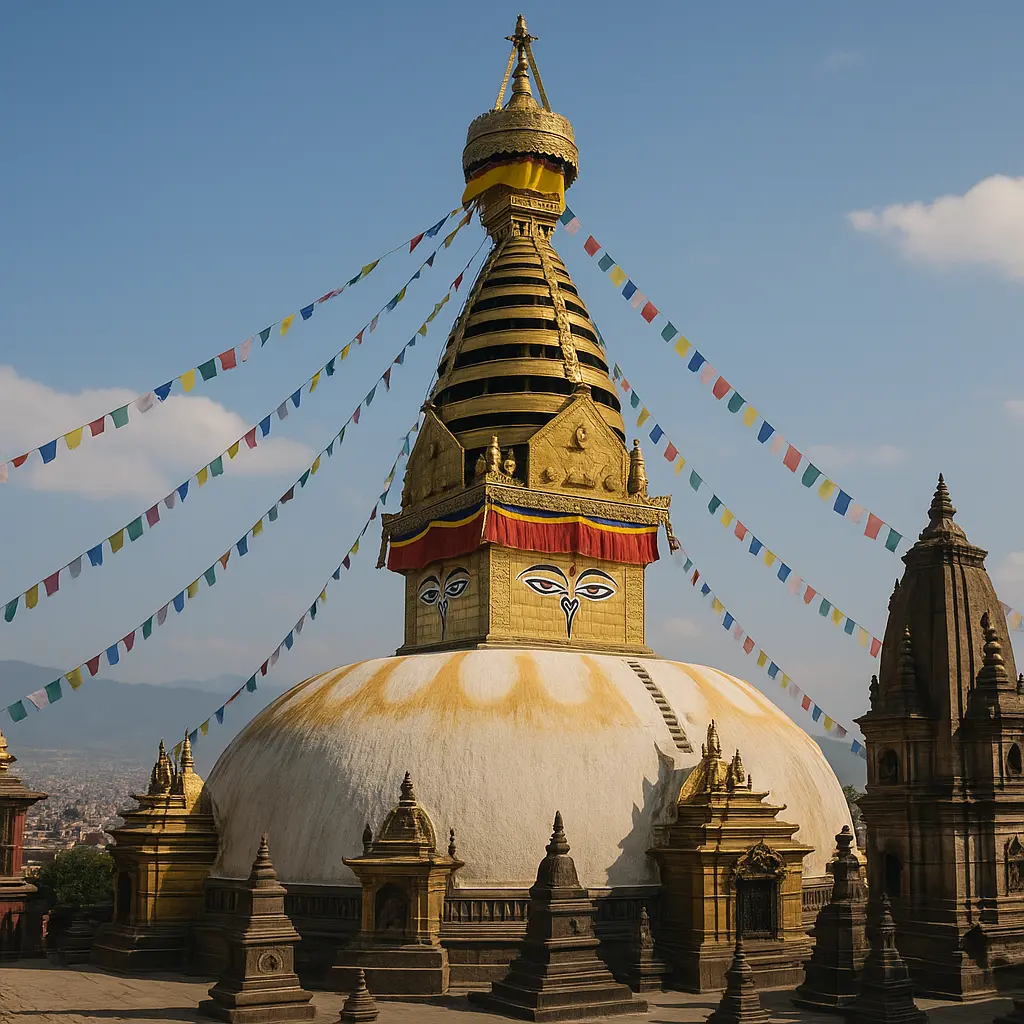
The Living Legend Behind Swayambhu
Before there was a city, before the valley held even a whisper of Kathmandu, there was a sacred light shining from a lotus on a lake.
That light, say the ancient texts, is the origin of Swayambhunath.
“Swayambhu” means “self-arisen.” It’s believed that the hill and the stupa emerged from the lotus itself, not built by human hands but by divine forces. That story still pulses through the air here, especially in the early morning mist, when the stupa glows softly as if remembering its own myth.
At the heart of the stupa, the Eyes of the Buddha look out not with judgment, but with timeless calm. Between the eyes sits the Nepali number one, a symbol of unity. Above them, the thirteen golden steps of the spire represent the stages on the path to enlightenment.
This isn’t just a monument. It’s a living mandala, vibrating with the prayers of pilgrims who’ve walked these steps for generations.
Sacred Symbols in Stone and Wind
When you walk around the main dome, prayer wheels spin under your fingers and small chaityas line the paths like silent sentinels. The golden vajra at the stupa’s front rests on a base with four lions, symbolizing strength and protection.
What makes Swayambhunath so unique is its spiritual harmony. Though it’s one of the most important Buddhist sites in Nepal, Hindu shrines stand beside Buddhist temples with no contradiction. You’ll see a statue of Harati, a Hindu goddess turned Buddhist protector, lovingly tended with marigold offerings.
Everything here is intentional. The white dome represents the world. The square base with painted eyes is wisdom. The thirteen golden tiers of the spire mark spiritual realization. And the fluttering prayer flags carry the hopes and mantras of everyone who’s come seeking peace.
Climbing the Steps to Stillness
There are 365 steps to the top. One for every day of the year. Some say it’s a test of devotion, others call it a spiritual exercise. Whatever your reason, the climb is worth every breath.
You’ll pass wild monkeys playing near carved stone lions, old women in saris spinning wheels, young monks carrying water in metal buckets. The scent of juniper smoke blends with the faint ringing of bells.
At the top, all of Kathmandu stretches before you. But the real view is inward.
Come at sunrise when the sky is still a soft blue. Or come at dusk when golden light bathes the spire and pigeons circle like slow-moving prayers. There’s no wrong time. Only your own rhythm.
Visiting with Heart and Respect
To enter this sacred space, it helps to slow down. Move clockwise around the stupa. Step gently. Speak softly. Watch how others walk, pause, and bow.
Here are a few simple guidelines to honor the space:
• Take off your shoes before entering the shrine halls.
• Don’t point your feet at statues or altars.
• Avoid loud conversation or phone use.
• Ask before taking close-up photos, especially of people or pujas.
• Don’t feed the monkeys, no matter how curious they seem.
Respect isn’t a rule here, it’s a rhythm.
Around Swayambhu: Tea, Monasteries, and Hidden Corners
The temple grounds are just the beginning. Tucked into the hillside are several monasteries with resident monks, often open for quiet visitors. You’ll find murals, bells, and hidden courtyards with views few tourists discover.
Stop at a small teashop overlooking the valley. The masala tea tastes sweeter when sipped slowly, as prayer flags flutter in the wind.
You can also visit the nearby Natural History Museum or explore small ritual item shops selling butter lamps, incense, and carved singing bowls.
Every corner around Swayambhunath tells a story. You just have to listen.
Why Swayambhunath Still Matters
Some places fade with time. This one deepens. Swayambhunath is still an active pilgrimage site, alive with monks in red robes and elders counting beads under ancient trees.
But it’s more than ritual. It’s a rare symbol of religious harmony. A place where Hindu and Buddhist energies coexist without division. A place where travelers, artists, seekers, and locals come not just to take pictures, but to feel something ancient, something still.
It’s also a living teacher. Its architecture holds wisdom. It’s silence, a kind of teaching. It’s rituals, a reminder that the sacred isn’t always loud.
Where to Stay for a Deeper Connection
If Swayambhunath stirs something in you, consider staying nearby in a place where that sense of quiet can continue.
Just a short drive away in Boudha, you’ll find Boudha Mandala Hotel, a peaceful, spiritually aligned retreat just ten seconds from the great stupa. With long-stay apartments, stupa-view balconies, and an in-house café serving organic meals, it’s designed for pilgrims, creatives, and digital nomads alike.
When you stay nearby, you don’t just visit sacred sites, you live alongside them. You hear the morning chants. You sip your tea under prayer flags. You become part of the rhythm.
Final Reflection
As you descend the steps from Swayambhunath, don’t be surprised if you feel lighter, quieter, somehow more spacious.
Because this temple isn’t just watching over the city. It’s inviting you to remember the stillness within yourself.
And perhaps, that’s the real pilgrimage.