
Introduction
There are places in the world where words come softly, like prayer. Boudhanath is one of them. Poets often describe it not as a location, but as a mood. A rhythm. A stillness that seeps into the soul and flows out as verse.
Walk a slow kora in the early morning, and you’ll feel it too. The air holds incense and possibility. The chants echo like ancient syllables still searching for paper. For many poets, foreign and Nepali alike, Boudha has been more than a setting. It has been a teacher.
This is a look at some of the voices who sat by its walls, listened, and wrote.
Allen Ginsberg (USA)
Ginsberg, one of the great American Beat poets, passed through Nepal in the 1960s during his spiritual explorations. His poetry from this period reflects his fascination with Buddhist practice and the sacred geography of Kathmandu.
Though he’s more often associated with Bodh Gaya or India, those who’ve traced his letters and journals know he visited Boudhanath too. The spinning wheels, butter lamps, and chants left a mark.
“Holy Boudhanath, great eye of Kathmandu…”
, A line scribbled in one of his travel journals
Yuyutsu Sharma (Nepal)
Born in Nepal and known internationally, Yuyutsu RD Sharma has written widely about Himalayan life, spirituality, and Kathmandu’s changing landscape. In his poems, Boudha appears not just as a holy site but as a breathing character, full of longing and wisdom.
From his collection “Annapurna Poems” to his meditations on Himalayan culture, Sharma weaves Boudhanath’s presence into metaphors of wind, silence, and light.
Jane Hirshfield (USA)
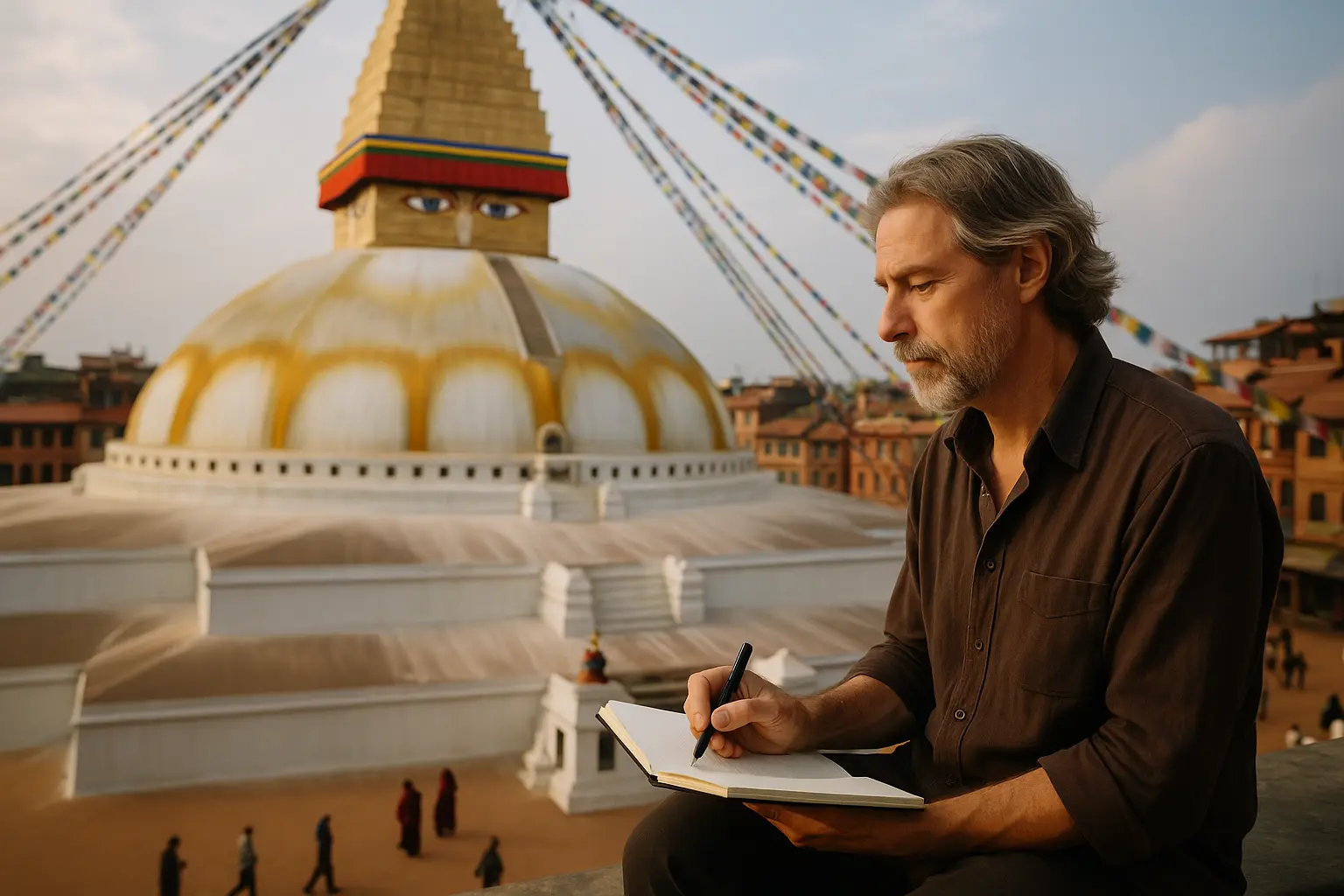
While not always directly associated with Boudha, Hirshfield’s retreat to Kathmandu in the early 2000s, documented through interviews and travel notes, sparked a wave of inward-facing poems. Visitors remember her sketching verses near stupa cafés, writing in silence as pigeons circled the dome.
Her Buddhist background and meditative style make it easy to imagine Boudhanath’s mandala-like presence shaping her metaphors.
Tsering Wangmo Dhompa (Tibet/Nepal)
Tsering, the first Tibetan female poet to be published in English, spent time in Boudha reconnecting with family, culture, and language. Her poetry often explores themes of displacement, identity, and longing.
In works like “My Rice Tastes Like the Lake”, the spiritual spaces of Boudha appear gently, almost like dream fragments, a butter lamp’s flicker, the sound of bells, the motion of devotion.
Her reflections on Tibetan diaspora are deeply resonant with the Boudha landscape, where many exiled Tibetans have built new sacred homes.
Manjushree Thapa (Nepal)
Though primarily a novelist and essayist, Thapa’s lyrical prose and occasional poetry often touch on the sacred geography of Kathmandu. She has written beautifully about ritual, place, and the quiet dignity of Buddhist tradition.
Boudhanath, as a recurring location in her essays, serves as a contemplative space, especially in moments where she describes the intersection of personal and cultural memory.
Michael Hettich (USA)
An American poet who spent a brief sabbatical time in Nepal, Hettich wrote about the “suspended quiet” of Boudhanath in several of his travel pieces and unpublished poems. One of his lines captures it simply:
“The stupa watched without blinking, as we whispered the rest of our lives.”
Though less known in literary circles connected to Nepal, his poems shared in writer retreats in the Valley held Boudha in soft reverence.
Boudha as Living Verse
Boudha does not perform for tourists. It breathes for those who sit and listen. For poets, that’s all it takes. In the slow movement of monks, the spiral walk around the dome, the thrum of chants that dissolve thought, language awakens.
Even anonymous poets, nuns with notebooks, and travelers scribbling lines into weather-worn journals find voice here. The outer kora becomes a page, each step a word.
Why Boudha Inspires Poets
It’s not just the architecture or the rituals, but the atmosphere. The sense that something ancient continues to unfold, without rush. For a poet, that’s nourishment.
Poets find in Boudha:
• Stillness that sharpens language.
• A rhythm that mirrors poetic breath.
• Symbols, like prayer flags or lamps, that become metaphors.
• A community where silence is shared, not feared.
• Moments that unfold, rather than demand to be captured.
Where to Stay for Poetic Retreats
If you’re a writer or poet planning a long stay in Boudha, being close to the stupa is a gift. Boudha Mandala Hotel, just 10 seconds from the main gate, offers quiet rooms with stupa views, perfect for journaling or reflection.
The on-site café serves local teas, and it’s not uncommon to see monks reading, writers scribbling, or someone quietly working on a poem about the morning light.
Final Reflection
You may come to Boudha with a pen, but you’ll leave with a pause. Something inside will have slowed, grown spacious. Perhaps that’s why so many poets return, or never quite leave, at least in verse.
Because Boudhanath doesn’t just inspire poetry.
It teaches you how to listen.