Key Takeaways
Tibetan prayer flags and butter lamps aren’t just decorations; they’re sacred symbols of compassion, clarity, and connection. Prayer flags carry mantras on the wind, blessing all beings they touch, while butter lamps represent the light of wisdom, dispelling inner darkness. Together with rituals like kora and prostrations, these practices create a living expression of Tibetan Buddhism, especially in sacred places like Boudhanath. To witness or participate with respect is to step into a centuries-old circle of prayer, breath, and presence.
Introduction
It was just after sunrise in Boudha. The first butter lamps were flickering to life, glowing amber against the white of the stupa. Wind tugged gently at rows of prayer flags above, carrying blessings across the rooftops. A nun passed quietly, her hands on a worn mala, her gaze steady.
This wasn’t a show. It was devotion. Alive, quiet, and deeply human.
Many visitors to Boudhanath are drawn in by the beauty, the colors, and the rituals. But behind every fluttering flag and glowing lamp is a prayer, a teaching, a tradition lived for generations. This is a guide for those who want to see deeper, to feel what these sacred symbols truly mean.
What Are Tibetan Prayer Flags?
Prayer flags, or Lungta (རླུང་རྟ་), are more than decoration. They are wind-borne prayers, rooted in Tibetan Buddhism and even older Bon traditions.
There are five colors, each representing an element:
• Blue, Sky/space
• White, Air/wind
• Red, Fire
• Green, Water
• Yellow, Earth
Each flag is printed with mantras, usually Om Mani Padme Hum, and sacred symbols like the Wind Horse, which carries prayers to the heavens. As the wind passes through the cloth, the prayers are believed to bless all beings.
Prayer flags are not meant to be permanent. They fade, tear, and return to the earth, a reminder of impermanence. New flags are often hung on full moon days or during festivals like Losar (Tibetan New Year).
Why Are Prayer Flags Hung at Boudha and Other Stupas?
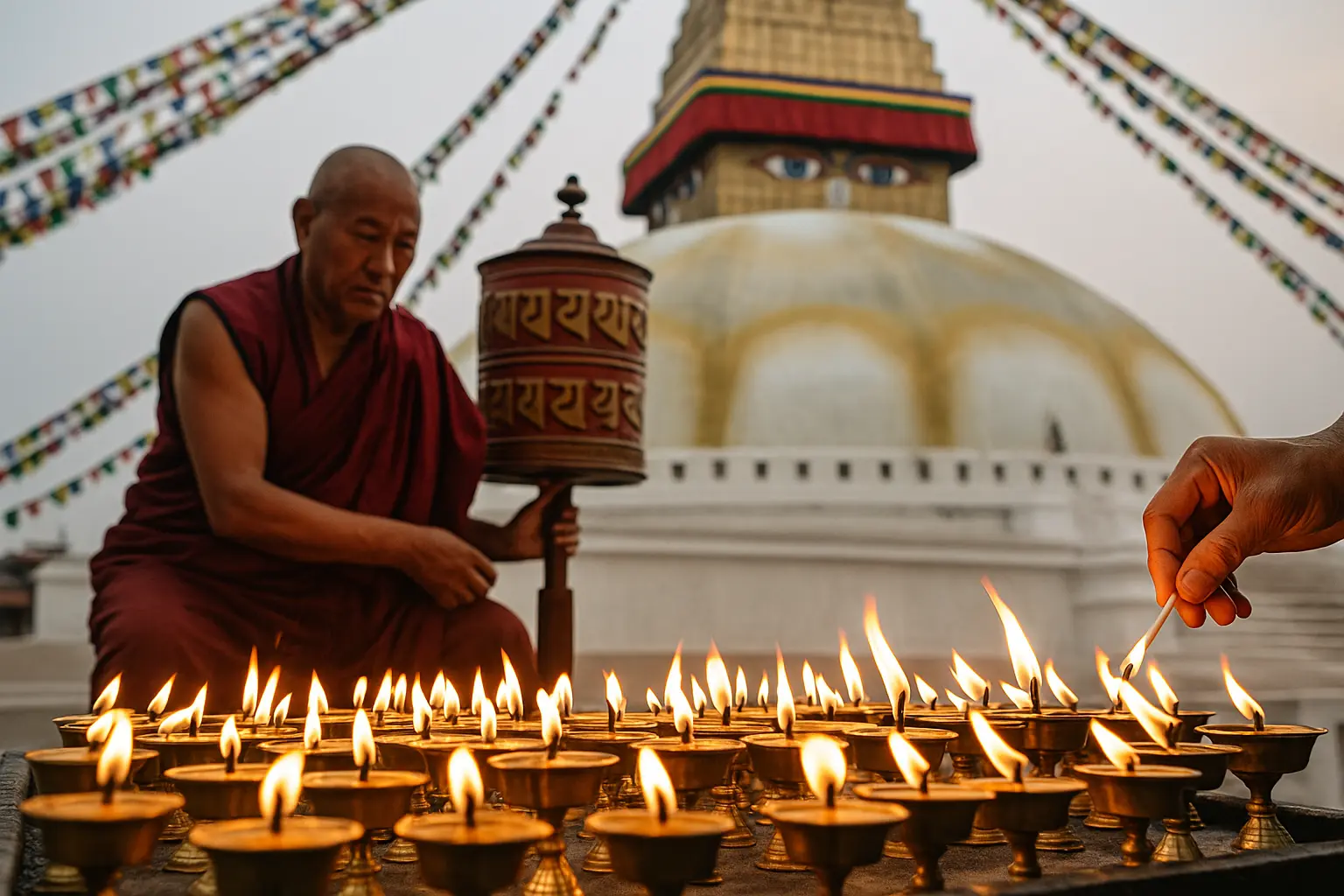
Boudhanath, one of the most important Tibetan Buddhist stupas in the world, is crowned with thousands of prayer flags. They stretch in geometric webs from the stupa’s peak to its base, dancing constantly in the breeze.
Hanging flags here is both an offering and a declaration. You’re adding your intentions to a collective prayer. The wind becomes your messenger.
Pilgrims often hang their own strings of flags before a long journey, after a family blessing, or in memory of a loved one. It’s not just what they mean, it’s what they carry.
The Deeper Meaning of Butter Lamps
To offer a butter lamp in Tibetan Buddhism is to offer light, both literal and symbolic.
The butter lamp (marme) represents the light of wisdom, cutting through the darkness of ignorance. In Himalayan monasteries, these lamps are offered daily during morning and evening pujas.
They’re traditionally made with yak butter, but now many use ghee or oil. You can see rows of lamps flickering around the base of Boudha Stupa, especially during dusk.
When you light a lamp with quiet intention, it becomes a prayer, for clarity, for healing, for someone who has passed.
According to Tibetan belief, offering lamps accumulates merit, especially when done with mindfulness. In some traditions, people offer 108 lamps at once, one for each delusion or obstacle in the mind.
Rituals You’ll See in Boudha (and What They Mean)
The stupa isn’t just surrounded by people, it’s circled by devotion. Each act you see has meaning:
Kora: Walking clockwise around the stupa, spinning prayer wheels, reciting mantras. It’s a moving meditation.
Prostration: A full-body bow done repeatedly, often for hundreds of cycles. It’s a physical expression of humility and purification.
Chanting: The most common mantra is Om Mani Padme Hum, associated with Avalokiteshvara, the bodhisattva of compassion.
Mala Beads: 108-bead strands used to count recitations of mantras. Each cycle is a journey inward.
All of these practices invite a slowing down, a shift from thinking to being.
How to Participate (or Observe) Respectfully
Whether you’re a pilgrim or a curious traveler, the key is presence and humility.
- Walk clockwise around stupas. Never against the flow.
- Speak quietly. Treat the space like a living temple.
- Dress modestly. Shoulders and knees covered is appreciated.
- Avoid selfies during rituals. It disrupts both the moment and the meaning.
- Buy prayer flags and lamps from monasteries or pilgrims. It keeps the intention clean, and supports the local spiritual economy.
Remember: you’re entering a sacred rhythm. Step lightly.
Staying Close to the Ritual
Living near Boudha, even for a few days, gives you something deeper than a visit. You begin to feel the timing of the rituals, the rhythm of the kora, the quiet before the morning pujas.
From the rooftop of Boudha Mandala Hotel, just 10 seconds from the stupa, you can see the flags unfurl, the lamps begin to glow, and the circle form again.
Whether you’re on a pilgrimage, writing a book, or simply needing stillness, this proximity brings you into the mandala of daily devotion.
Personal Reflection: One Morning Under the Flags
I once lit a butter lamp for someone I had lost. I didn’t know the prayers. I didn’t know the rituals. But I stood beside an old nun who nodded at me, as if saying, “You’re doing it right”.
She lit her lamp with trembling hands, and I followed. There was no language between us. But there was a connection.
That’s the thing about Tibetan rituals. You don’t always need to understand them to feel their truth.
Conclusion
Whether it’s a flag flapping in the wind or a flame dancing in stillness, these symbols stay with you. Tibetan rituals aren’t just things you see; they’re invitations to return to presence, to compassion, to light.
When you leave Boudha, you might not carry a prayer wheel or a mala. But the prayer stays, in how you walk, how you see, how you listen.