
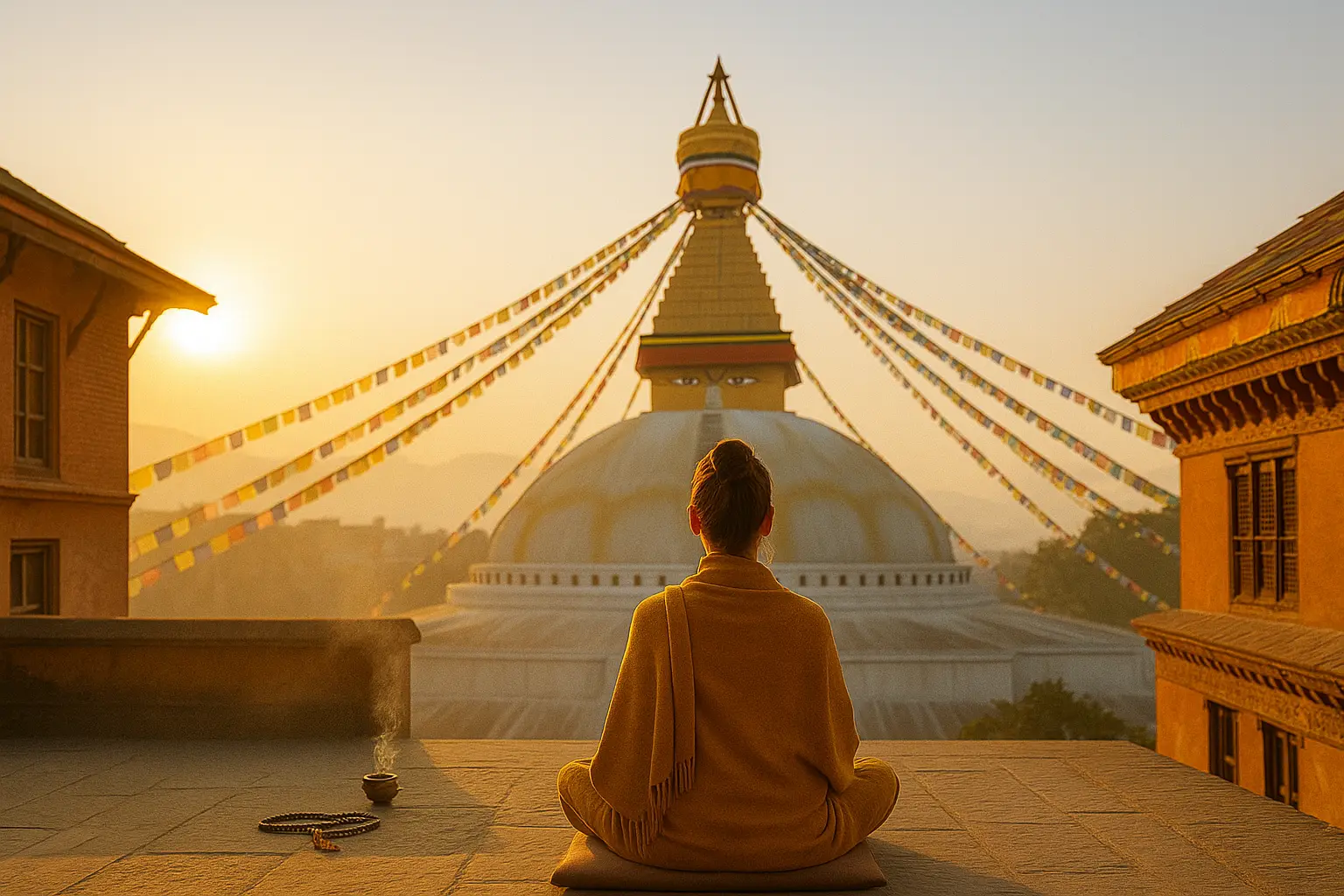
If you’ve ever searched for a meditation retreat in Kathmandu, you’ve likely felt that pull, the need to step away from noise and move toward something quieter and more grounded.
That’s why so many end up in Boudha.
Boudha feels like a different rhythm. Mornings begin with the low hum of chants and the soft turning of prayer wheels. So, what do you actually learn on a meditation retreat in Boudha?
Let’s take a closer look at the Buddhist meditation techniques from foundational breath practices to compassion-based methods rooted in Tibetan Buddhism.
Key Takeaways
The most common Buddhist meditation techniques techniques taught at Boudha retreats include:
– Shamatha (Calm-Abiding Meditation): A foundational breath-based practice to develop focus and mental stillness.
– Vipassana (Insight Meditation): Teaches you to observe sensations, thoughts, and impermanence with clarity and presence.
– Tonglen & Loving-Kindness (Metta): Compassion-based techniques that help open the heart and reduce self-centered thinking.
– Walking Meditation Around the Stupa: A unique local ritual of mindful walking and mantra recitation around Boudhanath Stupa.
– Mantra & Chanting Meditation: Sound-based practices using Tibetan mantras to calm the mind and connect with intention.
Why Boudhanath Feels Different
The stupa here has stood for centuries. It’s one of the most important sites in Tibetan Buddhism not just in Nepal, but in the world.
Around it, over fifty monasteries form a living circle of practice. You’ll hear chants, see butter lamps flickering at dusk, and feel something hard to describe.
Unlike Thamel or other tourist-heavy areas, Boudha moves slowly. It gives you permission to do the same.
Buddhist Meditation Techniques Taught in Boudha Retreats
Most retreats in this area are grounded in Buddhist tradition, especially Tibetan lineages. Whether you’re joining a group or practicing on your own, these are the buddhist mediation techniques you’re likely to learn.
Shamatha (Calm-Abiding Meditation)
This is the foundation. You focus on the breath, or sometimes a visual object. When your mind wanders which it will, you gently return.
That’s it. No pressure.
Shamatha trains attention and steadies the nervous system. You begin to notice space between thoughts. Many meditation retreats in Kathmandu use this as a base for deeper practices.
Vipassana (Insight Meditation)
Vipassana helps you see clearly. It’s not dramatic. You sit, observe sensations, and notice how everything changes, breath, sound, mood, thought.
This technique can be taught in both silent retreats and more interactive sessions. In Boudha, you’ll often find a Tibetan approach that includes guided reflection and time for questions.
It’s not about analyzing your life. It’s about learning to be with it, as it is.
Tonglen and Loving-Kindness (Metta)
These practices shift the focus from clarity to compassion.
In Tonglen, you breathe in discomfort or pain your own, or the world’s and breathe out relief, warmth, kindness.
Metta practice involves sending goodwill to others. You might begin with someone you love, then extend it to someone neutral, and eventually, even someone difficult.
Both techniques are common in retreats around Boudha, especially those led by Tibetan teachers. They balance awareness with heart.
Walking Meditation Around the Stupa
This isn’t always listed in retreat brochures, but it’s one of the most powerful practices here.
Each morning and evening, people walk slowly around Boudhanath Stupa. Some spin prayer wheels. Some count mala beads. Others just walk quietly, steady and present.
It’s informal but deeply meditative. You’re welcome to join anytime. No one will stare. No one will stop you.
You just walk.
Mantra and Sound Practices
Chanting is part of daily life in Boudha. Retreats often begin or end sessions with mantras, Om Mani Padme Hum is the most common.
You don’t need to sing well or believe in anything specific. You just let the rhythm carry your focus.
Some retreats include explanations. Others let the practice speak for itself. Both work.
Who Teaches These Practices?
Teachers in Boudha come from different traditions. Some are Tibetan lamas who’ve trained since childhood.
Others are Nepali monks, Western practitioners, or nuns fluent in English.
Most retreats are beginner-friendly. No robes, no dogma. Just real people sharing what they’ve learned, often with great care and humility.
You’ll find both structured retreats and informal drop-in sessions. The common thread is kindness and clarity.
What a Retreat Day Feels Like
Here’s a simple flow many Boudha retreats follow:
– Early morning meditation
– Silent breakfast
– Teaching or group practice
– Breaks for journaling or rest
– Afternoon session (chanting, compassion practice, walking meditation)
– Light dinner and evening reflection
Some retreats are silent. Others allow for questions and conversation. Most are gentle, respectful, and allow space for your own rhythm.
Where to Stay If You’re Practicing Near Boudha
Not everyone comes for a formal retreat. Some arrive needing quiet, and create their own rhythm.
Boudha Mandala Hotel is the one of the best hotels in Boudha that feels like a retreat.
It’s about 10 seconds from the stupa gates, but far enough from the crowds to stay peaceful. Here’s what it offers:
– Stupa-view rooms with small balconies
– Long-stay apartments with kitchens
– An organic café for quiet breakfasts
– Staff who understand retreat culture and respect your space
If you’re attending a meditation retreat in Kathmandu, or looking to do your own in a gentle way, this is a solid base.
What You’ll Actually Learn
The techniques matter. The teachers matter. But what you’ll really learn in Boudha is how to slow down.
How to listen. How to sit with yourself without fixing anything. How to walk a little more lightly in the world.
If that’s what you’re looking for, you don’t need to have it all figured out. Just come. Stay a few days. Let the place do its work.
Sometimes, the simplest practice is the most honest one.